The Maserati logo is built around a single recognisable object: a trident. Drawn from the statue of Neptune in Bologna, the mark has followed the Italian marque from its first racing season in the 1920s to today’s electric era, outlasting almost every other part of the company’s identity.
Origins in Bologna
Maserati began in Bologna, where brothers Alfieri, Ettore and Ernesto Maserati opened their workshop. The company dates its official operations to 1 December 1914, as recorded in Maserati’s own anniversary history. The Trident was the work of a fourth brother, Mario, an artist and the only one of the siblings outside the engineering side of the business.
Mario turned to Bologna’s Fountain of Neptune for the symbol, taking the trident held by the sea god, as Design Week and Hemmings both record. That reference anchors the marque to its home city, whose civic red and blue later inform the badge’s palette. Maserati attributes a first drawing of the logo to Mario in 1925, though that date is not firmly documented. What is certain is the racing debut: the Trident appeared on the Tipo 26, which first ran on 25 April 1926 at the Targa Florio and won its 1.5-litre class with Alfieri driving, according to Hindustan Times. Maserati’s centenary of the Trident is measured from 1926, which places the logo’s first use in that year.
The first badge and the move to an oval
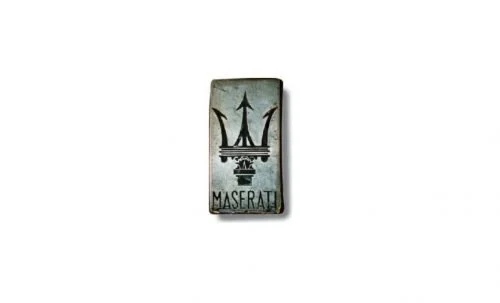
The earliest version was a vertical rectangular form in silver-toned metal, with the trident drawn in fine detail and the wordmark set beneath it in capital letters. It reads as a badge of its period: literal and ornate, closer to a plaque than to a modern brand mark.
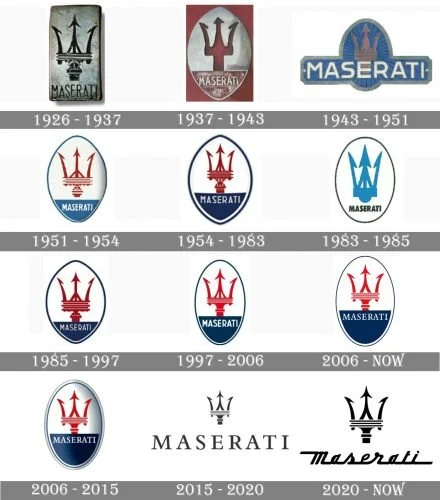
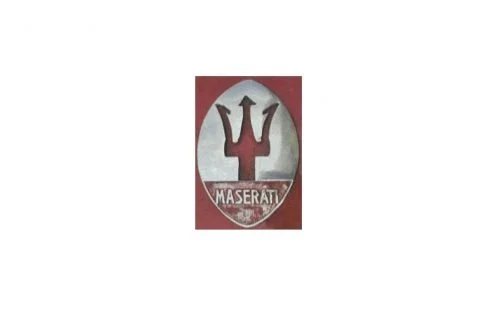
By the early 1930s the shape had shifted to an oval. Hemmings dates the change to 1933, while other accounts place it more loosely in the early 1930s, and the exact year remains unsettled. The oval introduced the arrangement that became standard, a red trident against a coloured field with the wordmark in a band across the lower part of the badge.
Modena and the long-lived oval
Ownership changed in 1937, when the Orsi family acquired the company, a transition recorded by Treccani. Production moved from Bologna to Modena in 1939, and the Viale Ciro Menotti plant opened on 1 January 1940, per Stellantis press material. The move did not alter the badge’s basic form, and for decades Maserati kept the oval.
What changed through the mid-century was subtler. Hemmings notes that the white field behind the red trident shifted to silver in the 1970s and to a dark cream in the 1980s, while the oval’s ring was red, then silver, then disappeared altogether. A later badge revision is variously placed in 1980 and 1983, a pair of dates that continue to circulate. A simplified variant in the mid-1980s did not last long before the traditional oval returned.
Ownership changes and the 1997 refresh
Maserati’s corporate history passes through several owners. Fiat acquired the company in 1993, Ferrari took control in September 1997 and held it until 2005, when it returned to the Fiat Group; FCA followed in 2014 and Stellantis in 2021, as set out by Store norske leksikon and Maserati’s own accounts. Earlier Citroën and De Tomaso phases are dated inconsistently across sources.
The badge was refreshed in 1997 under Ferrari control. Maserati’s own press kit describes a further restyling in 2005 as the last update before the modern era, while many logo summaries date a comparable version to 2006. Either way, the period kept the oval, the red trident and the blue band carrying the wordmark.
The 2020 redesign
The current identity was revealed in September 2020 alongside the MC20, at an event the company called MMXX. It was designed in-house by Centro Stile Maserati in Turin, according to Design Week. The changes were structural rather than decorative. Red was removed from the palette, leaving white and a deep lacquered blue the brand calls Maserati Blue; the trident’s side arrows were rounded and the spacing retuned; the wordmark was refined and simplified; and glossy finishes gave way to satin chrome, as Motor1 reported.
The blue is not purely aesthetic. It signals the brand’s electrified models sold under the Folgore name. The C-pillar Saetta badge was simplified as well, dropping its oval frame and lightning bolt.
Symbol and emblem
The Trident’s meaning rests on a single documented link: the Fountain of Neptune in Bologna. Neptune’s trident stands for the god’s strength, and the reference ties the marque to the city whose colours inform the badge. Beyond that, the familiar explanations about the three prongs representing perfection or harmony, or about an invented relationship between the trident’s base and the radiator grille, are not supported by reliable sources.
Structurally the emblem has been remarkably stable: a trident centred in an oval, with the name in a band below or across it. The frame, the field colour and the lettering have all been adjusted repeatedly, but the core object has never been replaced.
Disclaimer
This article is part of the educational resources provided by Logo Index, an independent archive covering logos, visual identities and graphic design history. Maserati and associated trademarks and brand assets remain the property of their respective rights holders where applicable.