Noble Automotive Ltd. is a British manufacturer of low-volume, hand-assembled sports cars, founded in 1999 by Lee Noble in Leeds, West Yorkshire. Its cars are rear-mid-engined and deliberately light on driver aids, and its identity has proved unusually stable for a marque of that size. Rather than resetting its badge with each new model, the company has kept the same name on the nose of the car and registered a single crown-like device as its official mark.
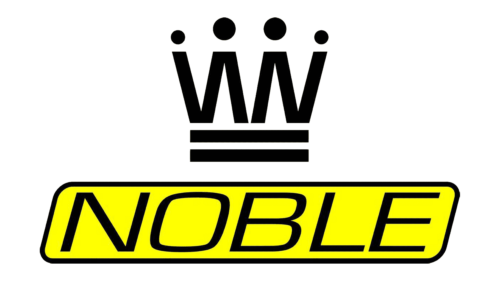 Noble Logo PNG
A coronet, not a crest
The clearest documented element of Noble’s identity is a United States design mark. Registered as no. 5877817, the record describes the mark simply as a “coronet design” and places it in the design category for crowns that are open at the top. The registration states that colour is not claimed, so colour is not a legally claimed feature of the mark. The application was filed on 7 September 2018, claiming priority from a United Kingdom filing made the previous day, and it registered on 8 October 2019 across classes covering vehicles and related goods.
That is essentially all the record says. The mark description runs to a single phrase, with no typeface, palette or statement of intended meaning attached to it. Readings of the coronet as a chess queen, or as two mirrored Ns, appear on logo-directory sites but are not attributed to Noble or to any designer, so they read as interpretation rather than documented symbolism.
The name as the first mark
Before the coronet, Noble protected the word itself. A UKIPO word mark for “Noble” was filed on 19 August 2004 and registered on 25 August 2006. A second UKIPO mark, “NOBLE”, was filed on 11 December 2006 and registered on 18 January 2008, with Noble Automotive Ltd named as owner and Howes Percival LLP recorded as legal correspondent. Both are word marks rather than stylised logotypes, which means the registered protection covered the name rather than a particular letterform.
An earlier attempt in the United States did not survive. The USPTO word mark NOBLE, serial 77063952, was filed on 14 December 2006 and abandoned on 13 November 2007 after a failure to respond.
Interbrand and the 2001 identity
The earliest documented formal identity work belongs to the company’s first trading name. In its opening years the firm traded as Noble Moy Automotive, after backer Tony Moy. In March 2001, Design Week reported that Interbrand had been appointed to create the company’s identity, website and graphics after the success of the M12. The revamped identity was scheduled to appear later that year, and the report notes that the car featured the Lee Noble name as a brand for the first time. That is the earliest dated rebrand on record and the only agency credit that can be attached to Noble’s identity programme.
Whether the same project produced the coronet device is not established in the published record; the design mark entered the trademark system more than seventeen years later.
How the mark outlived its founder
Noble’s badge is not tied to its founder’s tenure. Lee Noble sold the company to car collector Peter Dyson in August 2006 and left in February 2008, going on to found Fenix Automotive in 2009, while the business later relocated to the Leicester area. Cars built afterwards, including the M600 revealed in 2009 and produced through 2018, carried an identity that had already been separated from the man whose surname supplies it.
In the United States the protection lapsed. A notice from Noble’s website, reproduced on PistonHeads, records that the US trade mark had been let go and was later adopted by an unrelated company, Turbo Hoses, with which Noble has no connection. The UK registrations remained with Noble Automotive Ltd.
For a manufacturer of this size, that is a fairly ordinary outcome: a simple device, a name that does the heavy lifting, and paperwork that follows the business through changes of hand. The coronet is the one part of the identity that was formally drawn and recorded, and it remains the most specific thing that can be said about the Noble logo. Other British low-volume supercar makers take a similar route, as the Ultima mark shows, building recognition on a single device rather than an elaborate crest.
Disclaimer
This article is part of the educational resources provided by Logo Index, an independent archive covering logos, visual identities and graphic design history. Noble and associated trademarks and brand assets remain the property of their respective rights holders where applicable.