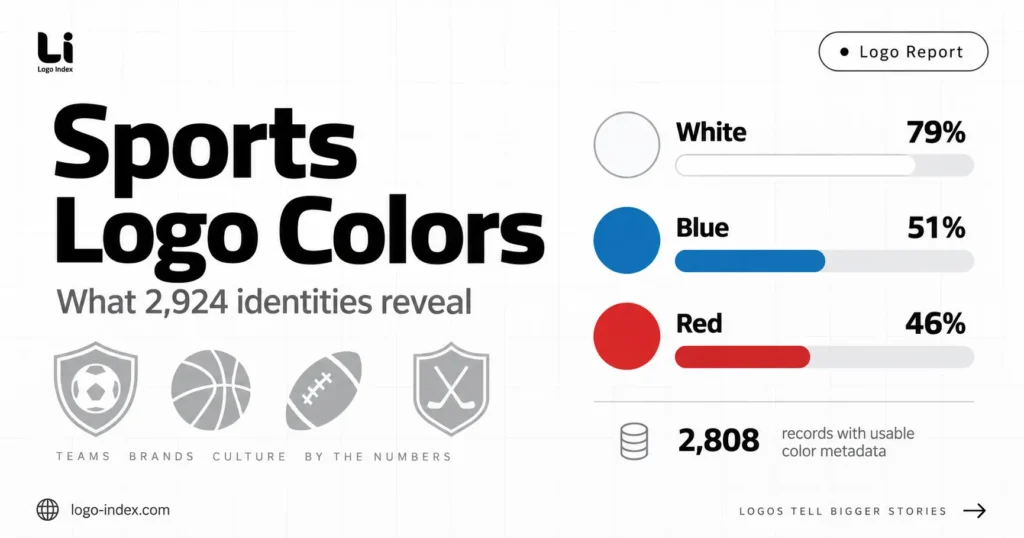
What colors appear most often in sports logos? Logo Index analyzed 2,924 identities in its Sports archive to find out. Of those, 2,808 records contained usable color metadata, giving this study color coverage of approximately 96%.
White appears most often, recorded in 79.2% of usable sports-logo records. Blue follows at 51.2%, while red appears in 45.7%. Gray, orange and gold also occur frequently across the archive.
These figures describe the sports identities documented in Logo Index rather than every sports logo ever created. The purpose of the study is to identify recurring patterns inside a large structured logo archive without turning those patterns into unsupported claims about design psychology or universal branding rules.
Dataset analyzed: 2,924 Sports records · Usable color records: 2,808 · Analysis: September 2026
Key Findings
- White appears in 79.2% of sports-logo records with usable color metadata.
- Blue appears in 51.2%.
- Red appears in 45.7%.
- Gray appears in 31.5%.
- Orange appears in 28.8%.
- Gold appears in 21.7%.
- Color metadata is available for 2,808 of the 2,924 Sports records.
- Because many identities use several colors, the percentages are not expected to total 100%.
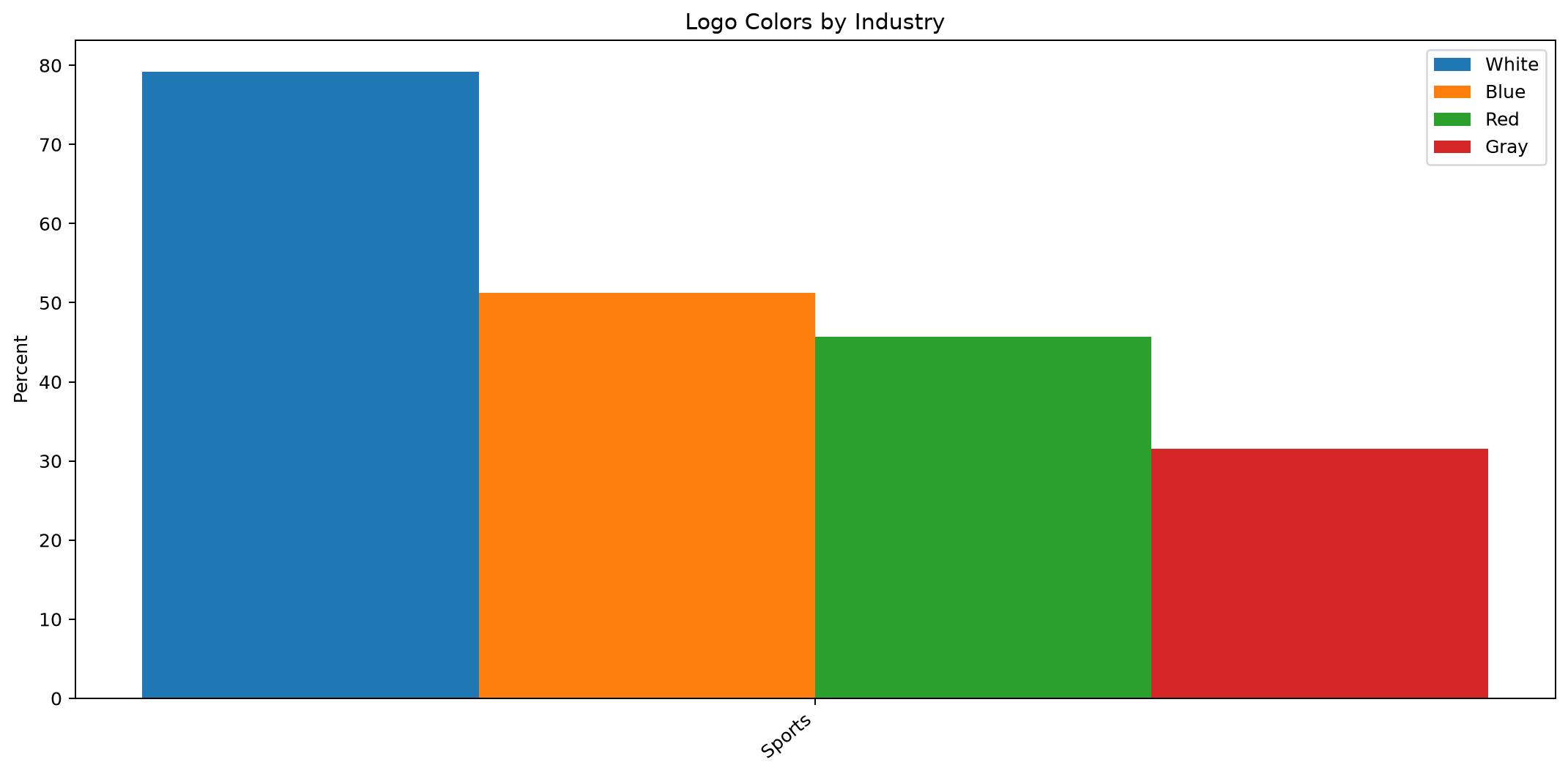
Figure 1. Share of sports-logo records containing each of the six most frequently recorded normalized color families.
The Most Common Colors in Sports Logos
| Color family | Share of usable sports-logo records |
|---|---|
| White | 79.2% |
| Blue | 51.2% |
| Red | 45.7% |
| Gray | 31.5% |
| Orange | 28.8% |
| Gold | 21.7% |
The clearest result is the prevalence of white. It appears in nearly four out of every five sports identities for which Logo Index has usable color data.
This does not mean that most sports logos are primarily white. The analysis records whether a color family appears somewhere in the identity’s metadata. It does not measure how much visual area that color occupies or whether it functions as the primary, secondary or accent color.
Blue and red form the next tier. Blue occurs in slightly more than half of the usable records, while red appears in slightly less than half.
Gray, orange and gold are less frequent but still substantial. Each appears in more than one fifth of usable sports identities, showing that the archive contains a broader palette than a simple white-blue-red hierarchy might suggest.
What the Leading Colors Actually Tell Us
The dataset supports conclusions about frequency. It does not establish a universal meaning for an individual color.
For example, this study cannot demonstrate that blue was selected to communicate trust, that red was selected to communicate energy, or that white was selected to communicate simplicity. Those explanations would require evidence from the individual organization, designer or brand guidelines.
What can be established is more useful for archive-level research: white, blue and red recur across a large share of the sports identities documented in Logo Index.
That creates testable follow-up questions. Researchers can examine whether certain countries use one family more heavily, whether specific types of sports organizations differ from the overall archive, or whether particular visual motifs tend to appear with particular palettes.
Why the Percentages Add Up to More Than 100%
Many sports identities use more than one color. If a logo is recorded with blue, red and white, it contributes once to each of those three color-family totals.
The analysis therefore measures color presence, not mutually exclusive categories.
White’s 79.2% figure means that white appears somewhere in the recorded palette of 79.2% of usable sports-logo records. It does not mean that 79.2% of those logos are white-only identities.
Examples From the Logo Index Sports Archive
The Sports archive contains identities from different countries, periods and design traditions. The examples below illustrate the range of material behind the dataset rather than suggesting that any single identity represents the overall color pattern.


These examples also show why color alone cannot describe sports-logo design. The archive contains typographic marks, abstract symbols, geometric systems and other visual approaches that can use similar palettes in very different ways.
What the Results Mean for Sports Logo Research
The most useful conclusion is not that sports identities follow one universal palette. Instead, the data establishes a baseline against which narrower groups can be compared.
If white appears in 79.2% of the overall Sports archive, for example, a particular country or sports category with substantially lower white usage would represent a meaningful difference worth investigating.
The same applies to blue and red. Their high overall frequency makes them useful reference points for more specific studies rather than evidence that every sports identity should use them.
This approach can also help designers conducting competitive research. A common color does not automatically make an identity generic, and an unusual color does not automatically make it distinctive. Shape, typography, symbol construction, composition and the relationship between colors remain important parts of the complete visual system.
What the Data Can and Cannot Tell Us
The strongest advantage of this dataset is its scale: 2,808 sports identities contain usable color information.
However, the analysis does not determine:
- which color occupies the largest area of a logo;
- which color is officially designated as primary or secondary;
- whether a recorded color belongs to a current or historical version;
- why a particular organization selected its palette;
- whether a color was inherited from a club, city, flag, sponsor or earlier identity;
- how consistently the palette is used across uniforms, digital assets and other applications.
Those questions require brand-specific research or more detailed image-level analysis.
For that reason, this study avoids generic color psychology and treats the results as frequency data rather than evidence of design intent.
Methodology
Logo Index filtered its archive to 2,924 records categorized under Sports. Of those, 2,808 records, approximately 96.0%, contained usable color metadata.
Color labels were normalized into broad families so related values could be compared consistently. When multiple colors were recorded for one identity, that record could contribute to several different families. A single identity was counted only once within each individual family.
The analysis therefore answers a specific question:
How frequently does each normalized color family appear among Sports records with usable color metadata in the Logo Index archive?
Dataset Coverage
| Field | Coverage |
|---|---|
| Country | 100.0% |
| Industry | 100.0% |
| Color | 96.0% |
| Tags | 100.0% |
| Image URL | 100.0% |
| Year | 9.7% |
| Designer | 3.6% |
| Agency | 2.2% |
| Styles | 0.0% |
Color, country and tag metadata are substantially more complete than year, designer or agency information in this subset.
Because only 9.7% of the records contain usable year metadata, this report does not make broad claims about historical color trends. Designer and agency coverage is even lower, so those fields are not used for archive-wide authorship conclusions.
Limitations
- The Logo Index archive is not a statistically representative sample of every sports logo in existence.
- The study measures recorded color presence rather than visual dominance.
- Normalization into broad color families removes distinctions between some shades.
- Multi-color identities can appear in several totals.
- The dataset contains different types of sports organizations rather than a single league or sport.
- Historical comparisons are limited by relatively low Year-field coverage.
- Designer and agency metadata is not complete enough for broad authorship conclusions.
Why This Dataset Is Useful
Many discussions of sports-logo color begin with a small selection of famous identities and then generalize from those examples. A structured archive allows the question to be approached in the opposite direction.
Logo Index can begin with thousands of records, identify recurring patterns and then investigate the identities behind those patterns.
That approach supports more focused studies such as:
- the most common sports-logo colors by country;
- the most common two-color and three-color combinations;
- sports logos using circles, shields or letterforms;
- color differences between sports and other industries;
- regional differences in sports identity design;
- how frequently particular visual motifs occur within different color families.
These narrower comparisons can produce more useful findings than assuming that every sports identity behaves like the overall archive average.