 Audi Logo PNG
The Audi logo is one of the clearest examples of a corporate symbol whose meaning is officially documented. The four interlocking rings represent the four automobile manufacturers that came together in 1932 to form Auto Union AG: Audi, DKW, Horch and Wanderer. Audi continues to identify the rings as a reminder of those four founding companies. [1]
The history behind the name is equally specific. August Horch founded a second automobile company in Zwickau in 1909 after leaving the company that already carried his surname. Because he could not legally reuse “Horch” as the new marque, the name was translated into Latin. “Horch!” in German corresponds to “Audi!” in Latin, both meaning “listen” or “hear.” Audi says the suggestion came from Heinrich Fikentscher, the young son of one of Horch’s business associates. [2]
Quick Facts
- Company: AUDI AG
- Headquarters: Ingolstadt, Germany
- Founder of the Audi marque: August Horch
- New company established: 1909
- Audi company name adopted: 1910
- Four Rings introduced: 1932 with Auto Union AG
- Four founding marques: Audi, DKW, Horch and Wanderer
- Audi NSU Auto Union AG formed: 1969
- AUDI AG name adopted: 1985
- Current ownership: Volkswagen AG is the sole shareholder of AUDI AG [3]
- Current symbol: Four interlocking rings
Audi Logo Meaning
The four rings do not need speculative symbolism because Audi explicitly explains their origin. On June 29, 1932, Audiwerke AG, Horchwerke AG and Zschopauer Motorenwerke J. S. Rasmussen AG, the company behind DKW, joined together to form Auto Union AG. At the same time, the new group reached an agreement to take over the automotive division of Wanderer Werke. [4]
The newly formed company chose four interlocking rings as its emblem. Audi states that the symbol represented the unity of the four founding companies. Each marque initially retained its own name and market position, while the rings identified their membership in Auto Union. [5]
The rings therefore have a precise corporate meaning. Claims that the overlapping geometry additionally represents strength, perfection, engineering precision or universal unity should be treated as interpretation unless Audi itself documents those meanings.
What Does the Name Audi Mean?
August Horch established Horch & Cie. in 1899. After disagreements with the management of the company that bore his name, he left in 1909 and quickly founded another automobile business in Zwickau.
Horch could not legally use his surname again as a marque because it was already protected. Audi’s historical material explains that the solution was to translate the German imperative “horch!”, meaning “listen!” or “hear!”, into Latin: “audi!”. [6]
Audi records the story that ten-year-old Heinrich Fikentscher suggested the Latin translation while the adults were discussing possible names. The new company had originally been established in July 1909, and from April 25, 1910 it operated under the name Audi Automobilwerke GmbH, Zwickau. [7]
Audi Logo History
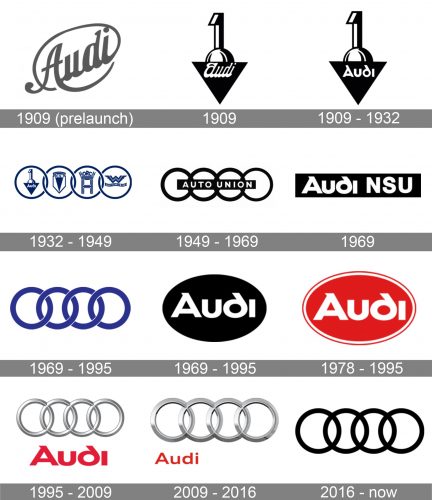
Audi’s visual history is more complicated than a simple sequence of redesigns because the Audi marque became part of Auto Union, disappeared from new-car production for a period, returned in the 1960s, and later became the name of the entire corporate organization.
1909: Early Audi Wordmark
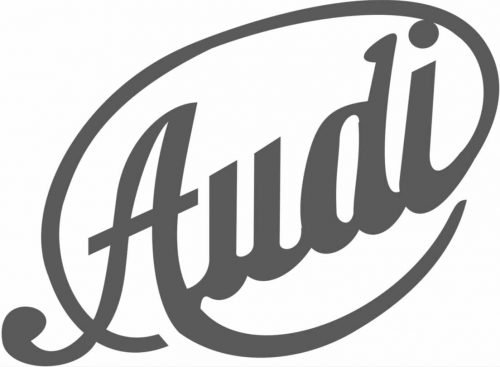
One early Audi treatment used a handwritten or script-style Audi name within an oval. It belongs to the earliest phase of the marque, when Horch’s second automobile business was establishing a distinct identity.
No authoritative Audi source located for this article assigns psychological meaning to the dark color or oval shape, so descriptions such as “professionalism” or “strictness” should not be presented as historical intent.
1909 to 1932: Audi Number One Emblem
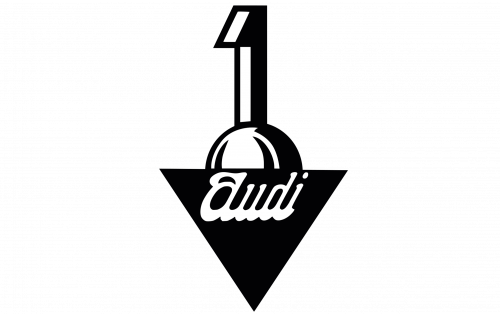
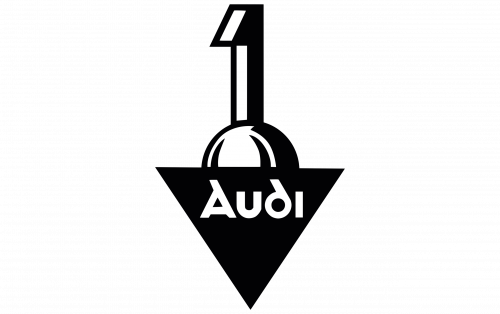
Another historic Audi emblem prominently used a numeral one above a dark triangular form carrying the Audi name in script. Variations of this design are associated with the pre-Auto Union Audi marque.
The visible number-one motif is distinctive, but no reliable primary source located for this article explains its original design brief or establishes that it was intended as a literal claim that Audi was the leading automobile manufacturer. It is therefore better to document what the badge contains rather than assign an unsupported meaning.
1932: The Four Rings Are Introduced
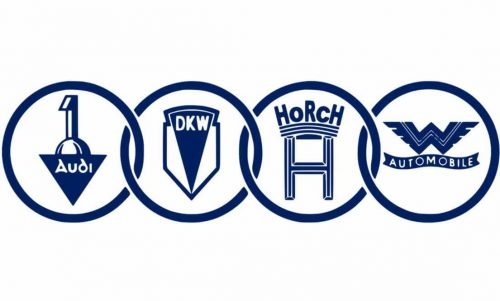
The decisive change came in 1932. During the global economic crisis, Audi, DKW, Horch and Wanderer joined forces to form Auto Union AG. The new company adopted the four interlocking rings as its corporate symbol. [8]
Early versions placed the individual emblems of Audi, DKW, Horch and Wanderer inside the four rings. This made the meaning of the symbol explicit: four established marques operating together within one group.
The rings were initially an Auto Union symbol rather than an Audi-only logo in the modern sense. Audi explains that the four founding brands continued to occupy distinct market segments within the group. DKW focused on motorcycles and small cars, Wanderer on mid-range cars, Audi on the upper mid-range and Horch on luxury automobiles. [5]
1949: Auto Union Re-established in Ingolstadt
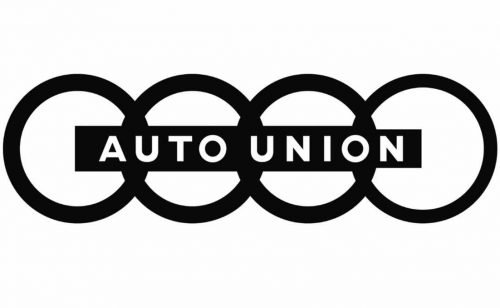
After the Second World War, Auto Union AG’s facilities in Saxony were expropriated and dismantled under the Soviet occupation. Former company executives moved west, and in 1949 a new Auto Union GmbH was established in Ingolstadt, Bavaria. It continued using the Four Rings. [5]
Postwar versions simplified the emblem by removing the four individual marque badges and using the rings with an Auto Union nameplate. This reflects the fact that the company itself, rather than four separately promoted logos inside the symbol, had become the primary identity.
1965 to 1969: The Audi Name Returns
The Audi marque returned to new-car production in the 1960s. Audi’s corporate history notes that a new four-stroke model was introduced under the Audi name in August 1965, providing the basis for a broader model range. [5]
This period is important because the Audi name gradually became more prominent than Auto Union in consumer-facing vehicle branding.
1969: Audi NSU Auto Union AG
In 1969, Auto Union GmbH merged with NSU Motorenwerke AG. The resulting company was named Audi NSU Auto Union AG. Audi’s historical record dates the merger agreement to March 10, 1969, with effect from January 1 of that year. [5]
This corrects a common oversimplification. Auto Union did not simply “become Audi” in 1969. The corporate name still included Audi, NSU and Auto Union until 1985.
1969 to 1990s: Rings and Audi Wordmarks
During the late 1960s, 1970s and 1980s, Audi used several wordmark and ring treatments across corporate material and vehicles. These included standalone rings and oval Audi wordmarks in black or red.
The supplied graphics document the visual variety of this period, but exact start and end years for individual secondary marks should be treated cautiously unless supported by period Audi identity manuals. Automotive companies frequently used vehicle badges, corporate marks and advertising wordmarks in parallel rather than replacing every previous mark on one exact date.
1985: AUDI AG
The modern corporate name arrived in 1985, when Audi NSU Auto Union AG was renamed AUDI AG. The company’s headquarters remained in Ingolstadt, and the Four Rings continued as the identifying symbol. [5]
This date is essential to understanding the identity. The rings began as the emblem of Auto Union in 1932, while AUDI AG as the present company name dates to 1985.
1990s to 2009: Three-Dimensional Rings
By the 1990s, Audi’s visual identity prominently used metallic, three-dimensional versions of the rings, often accompanied by a red Audi wordmark. This styling matched the rendering techniques widely used in automotive corporate identity during the period.
The rings themselves remained unchanged in their fundamental concept. The shift was mainly in surface treatment, dimensional rendering and the relationship between the symbol and the Audi wordmark.
2009 Corporate Identity Update
Audi introduced a new corporate design in 2009. Official Audi media material from September 2009 shows the Four Rings combined with updated Audi lettering and, in some applications, the “Vorsprung durch Technik” brand claim. [9]
The visual treatment retained dimensional metallic rings but gave the symbol greater prominence and modernized the typography around it.
2016: Flat Digital Treatment
Audi subsequently moved away from heavily rendered metallic effects toward a flatter, two-dimensional presentation suited to digital interfaces and flexible brand applications. The four-ring structure remained intact while color and dimensional effects were simplified.
Describing 2016 as the permanent introduction date of the “current logo” is now incomplete because Audi refined the vehicle version of the rings again in 2022.
2022 to Today: Refined Two-Dimensional Rings
In 2022, Audi introduced a newly designed version of the Four Rings on the Q8 e-tron. Audi described the treatment as two-dimensional, chrome-free and based on high-contrast black and white. The size of the emblem remained the same, while thinner lines and revised surfaces gave it a flatter appearance. [10]
The redesign is evolutionary rather than a new symbol. Audi has retained the same four interlocking circles whose corporate meaning dates to 1932.
Recent Audi vehicles have also expanded the physical treatment of the mark. In 2024 Audi described the A6 e-tron as the first production Audi to feature illuminated Four Rings at the rear, showing how the historic symbol continues to be adapted to new vehicle technologies without changing its basic geometry. [11]
Audi Typography
Audi has used multiple wordmarks and corporate type systems over its history. Early Audi emblems used script lettering, while later identities introduced heavier custom wordmarks and modern sans-serif typography.
Current Audi corporate applications use the company’s own Audi Type typeface family. Audi identity documentation specifically refers to Audi Type for dealership names and other corporate information. [12]
Modern font comparisons such as Allumi or Corbet should not be presented as the actual Audi typeface. They may resemble some letterforms visually, but Audi’s documented corporate type system is Audi Type.
Audi Logo Colors
Audi’s identity has used black, white, silver and red in different periods and applications. Historical three-dimensional logos frequently rendered the rings in metallic silver, while Audi wordmarks often appeared in red.
The current vehicle identity increasingly favors black and white ring treatments. Audi’s 2022 exterior-design guidance describes the revised rings as chrome-free and based on contrasting black and white surfaces. [10]
Color meanings such as black representing authority or red representing passion should not be presented as official Audi symbolism unless tied to an Audi design document. The better-supported identity story is the evolution from enamel and printed marks to metallic three-dimensional rings and finally to simplified two-dimensional applications.
Why the Four Rings Endured
The Audi rings have survived repeated corporate transformations because their historical meaning remained relevant. They first represented four independent marques forming Auto Union in 1932. After the Second World War, the re-established Auto Union GmbH retained them. They continued through the 1969 formation of Audi NSU Auto Union AG and remained in place when the company became AUDI AG in 1985.
That continuity makes the Four Rings more than a decorative automotive emblem. They are a visual record of the corporate lineage that eventually produced today’s Audi.
As of 2026, AUDI AG remains part of Volkswagen Group, and Volkswagen AG is its sole shareholder. Audi itself continues to describe the Four Rings as one of the company’s defining identifying symbols. [13]
FAQ
Why does the Audi logo have four rings?
The four rings represent Audi, DKW, Horch and Wanderer, the four automobile manufacturers brought together in 1932 to form Auto Union AG. Audi still identifies the rings as a reminder of those four founding companies. [4]
What does the name Audi mean?
“Audi” is the Latin equivalent of the German imperative “Horch!”, meaning “listen!” or “hear!” Founder August Horch adopted the Latin version because he could not legally reuse his surname for his second automobile company. [2]
When were the Audi four rings introduced?
The Four Rings were introduced in 1932 as the emblem of Auto Union AG. They originally represented the combined Audi, DKW, Horch and Wanderer companies and later became the identifying symbol of Audi. [1]
Who owns Audi today?
AUDI AG is part of Volkswagen Group. Audi’s current corporate-governance information states that Volkswagen AG is the sole shareholder of AUDI AG. [3]
Disclaimer
This article is part of the educational resources provided by Logo Index, an independent archive covering logos, visual identities and graphic design history. Audi, AUDI AG, the Four Rings and associated trademarks and brand assets remain the property of their respective rights holders where applicable.