 Bertone Logo PNG
Bertone is the name of Carrozzeria Bertone, later Gruppo Bertone, the Turin coachbuilding house founded in 1912 by Giovanni Bertone. Calling it an automaking brand undersells what it was. For most of the twentieth century Bertone was a carrozzeria: a workshop that drew bodies, built them in small series and, in time, manufactured complete cars under contract for Fiat, Lancia, Alfa Romeo, Lamborghini, Citroën, Volvo and others. The logo reflects that workshop culture. Its central device, a lowercase “b”, has been in use for the great majority of the company’s existence.
Meaning and history
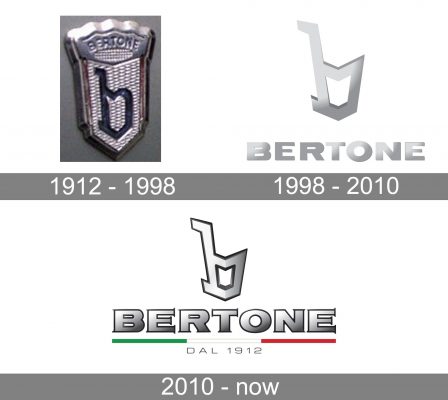
The visual identity has almost always rested on that single letter. The badge built around it changed repeatedly: a winged crest, a simplified shield, a bare chrome monogram, and finally a wordmark with the Italian tricolor beneath it. What follows tracks the documented badge history rather than the tidy decade-by-decade sequence common in logo roundups.
1932: the lowercase “b” becomes a trademark
Hemmings, in its specialist history of the marque, records the stylized lowercase “b” as an official Bertone trademark from 1932, the year the coachbuilder moved to larger headquarters in Turin. The badge of that period was a shield with wings on either side and five spires across the top, with the “b” set inside the crest. No specific logo has been reliably documented for the 1912 founding itself, so the winged shield is the earliest Bertone mark that can be dated with confidence.
Around 1950: wings removed, honeycomb added
By roughly 1950 the badge had been simplified. The wings disappeared, the crown elements at the top were reduced to a vestige, and the “b” sat over a honeycomb-patterned ground with the name BERTONE arched across the upper part of the shield. This is the emblem seen on cars such as the Alfa Romeo Giulietta Sprint, the Fiat 850 Spider and the Iso Rivolta.
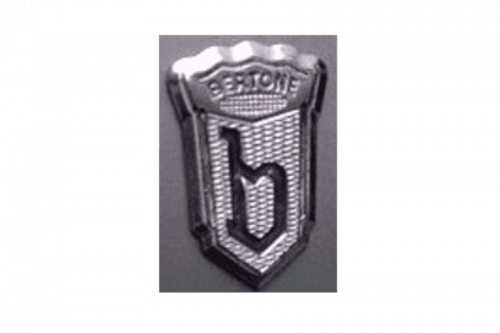
That shield is often filed online as the “1912” Bertone logo. The date is misleading. It belongs to the post-war period, while the earlier winged emblem dates from 1932.
1966: the “b” alone on the Miura
On the Lamborghini Miura, presented in 1966, the shield was gone. The lowercase “b” appeared as a chrome cutout fixed to the bodywork, and the Lancia Stratos later carried the same letter as a large decal. From this point the “b” worked as a standalone monogram rather than a device enclosed in a crest.
Later lockups and the final pre-bankruptcy mark
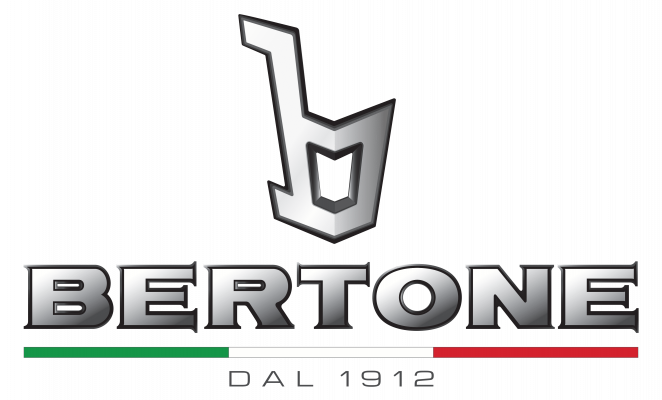
A later stage stacked the lowercase “b” above an uppercase BERTONE wordmark, both rendered in a metallic silver gradient.
The version used last, before the company’s collapse, kept that arrangement but added black outlining to the lettering, a horizontal green, white and red band, and the words DAL 1912 beneath it.
That tricolor “Dal 1912” lockup is frequently dated to 2010. It is certainly the mark Bertone was using when the company entered bankruptcy in 2014, but the exact introduction date is not well documented, and 2010 should be read as an approximation rather than a confirmed redesign year.
What the Bertone logo means
Three elements are supportable. The lowercase “b” is a stylized initial of Bertone. DAL 1912 means “since 1912”, a founding-date reference. The green, white and red band is a direct nod to the Italian flag. Readings of the letter as a musical note, or of its counter-space as an abstract heart, circulate widely in logo directories but have no documented basis in the company’s own history.
Colors and typography
The metallic silver of the monogram and lettering is plainly visible in the surviving artwork, but it reads as a photographic gradient rather than a specified brand color, and no official Bertone palette has been published. The only colors carrying a documented meaning are the tricolor green, white and red. The typefaces used across the badge’s history are likewise not documented by the company, so comparisons to particular commercial fonts are best read as visual resemblance rather than identification.
The company behind the mark
Giovanni Bertone founded the workshop in Turin in 1912, initially repairing carriages and building bodies. His son Giuseppe, known as Nuccio, took charge after the Second World War and turned Bertone into one of Europe’s most influential design houses, splitting the business into Carrozzeria Bertone for manufacturing and Stile Bertone for design. The cars associated with the studio include the Alfa Romeo Giulietta Sprint and the B.A.T. concepts, the Lamborghini Miura and Countach, the Lancia Stratos, the Fiat 850 Spider and X1/9, the Citroën BX and XM and the Volvo 780, alongside smaller projects such as the ASA 1000 GT. Bertone described itself simply as a symbol of Italian elegance and technical mastery, a positioning statement rather than an explanation of the logo’s construction.
Nuccio died in 1997, and Lilli Bertone led the company through a long decline that ended in bankruptcy in 2014. The name then passed through Bertone Design and later AKKA Technologies before Mauro and Jean-Franck Ricci acquired it in 2020 and revived the marque with the GB110 hypercar in 2022, a project that carries the same lowercase “b” identity forward.
FAQ
What does the Bertone logo stand for?
The lowercase “b” is the initial of Bertone and has served as the company’s core mark for most of its history. In the final version, DAL 1912 means “since 1912”, the year the coachbuilder was founded, and the green, white and red band refers to the Italian flag.
When did Bertone first use the lowercase “b”?
Specialist badge history records the stylized lowercase “b” as an official Bertone trademark from 1932, when it appeared inside a winged shield. Earlier marks from the company’s founding period are not reliably documented.
Why does the Bertone logo include the Italian flag?
The tricolor band is an explicit national reference rather than a hidden symbol. It was added to the badge in the company’s final pre-bankruptcy period, sitting beneath the lettering and above the words Dal 1912.
Did the Bertone logo change after the 2014 bankruptcy?
The marque passed through several owners before Mauro and Jean-Franck Ricci acquired it in 2020 and revived it with the GB110 hypercar in 2022. The lowercase “b” remained the recognisable anchor of the identity through that revival.
Is the silver in the Bertone logo symbolic?
No documented meaning is attached to the silver gradient beyond its visible use in the artwork. The only colors with a stated reference are the green, white and red of the Italian flag.
Disclaimer
This article is part of the educational resources provided by Logo Index, an independent archive covering logos, visual identities and graphic design history. Bertone and associated trademarks and brand assets remain the property of their respective rights holders where applicable.