De Tomaso Automobili is an Italian sports-car maker founded in Modena in 1959 by Alejandro de Tomaso, an Argentine-born racing driver and entrepreneur. Its badge is unusual among automotive marks because it is not really Italian at all. The original De Tomaso logo points to Argentina and to one specific family mark from the founder’s upbringing, which gives the emblem a meaning tied to a single biography rather than to a passing design trend.
 De Tomaso Logo PNG
Meaning and history
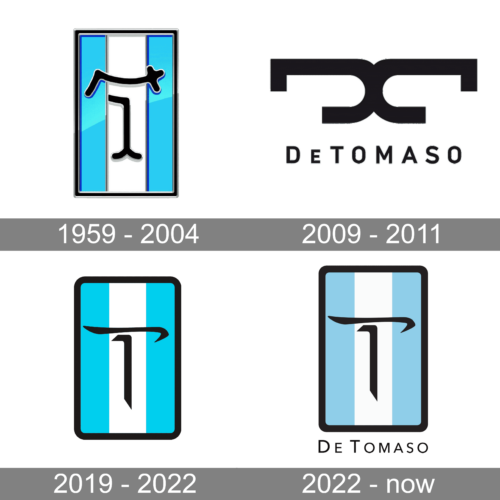
The overview graphic above illustrates how the emblem has been presented across different eras. It is useful as an at-a-glance summary, while the individual stages below are the ones with documented dates and sources behind them.
The founder’s badge (1959–2004)
De Tomaso started out building racing cars and prototypes before turning to road cars, and the models that built its reputation followed quickly: the Vallelunga in 1963, the Mangusta in 1966 and the Pantera in 1971. The original operating company, De Tomaso Modena, ran until its liquidation in 2004 and also owned Maserati between 1976 and 1993.

The badge from that era rests on two elements. The first is a field of light blue and white, the celeste colours of the Argentine flag. The second is the stylised “T” shape at the centre. Sources agree on what that shape represents: the cattle-branding mark of the Ceballos estate, the family property where Alejandro de Tomaso grew up. Bonhams Cars describes the symbol as “a cattle branding symbol for the Ceballos estate” shown against the Argentine flag’s colours, while Classic Driver reads the same mark as “a branding iron used to mark thoroughbred horses”. Wikipedia records the same explanation, making it the best-supported reading of the logo’s meaning. No reliable designer credit is documented for the original 1959 badge, which fits a mark drawn from the founder’s own family history.
The 2010 monogram by Peter Arnell
After the founder’s death and the 2004 liquidation, the De Tomaso trademark was bought in 2009 by Gian Mario Rossignolo, who set up a new company and attempted a revival. For that effort the brand adopted a fresh identity created by Peter Arnell, the New York designer and architect who served as the revived company’s chief innovation officer. According to Al Volante, the new logo was unveiled in August 2010 and was intended for cars headed to the 2011 Geneva motor show.
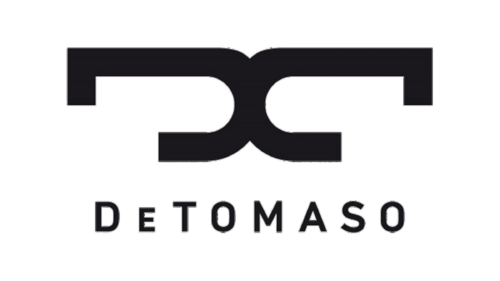
Arnell’s design was an abstract monogram that fused the letters “d” and “t”, described in contemporary reporting as symmetrical about a vertical axis. It marked a clear break from the family branding mark rather than an evolution of it. The logo never reached a production car: the Rossignolo revival collapsed and he was arrested in 2012, leaving the Arnell monogram as a documented but short-lived chapter.
The 2019 revival badge
Rights to the brand later passed to Norman Choi’s Ideal Team Ventures, which acquired them in the mid-2010s after a bankruptcy-court sale was approved in 2015 for around €1.05 million. On 15 May 2019, a company press release marking De Tomaso’s 60th anniversary announced a new logo “created for the next generation”. Coverage at the time, including AutoIndustriya, noted that the design kept the blue-and-white reference to Argentina and modernised the “T” rather than replacing it. The badge debuted alongside the P72, a car that pays homage to the 1965 P70 and was designed by Jowyn Wong, revealed at the Goodwood Festival of Speed on 4 July 2019.
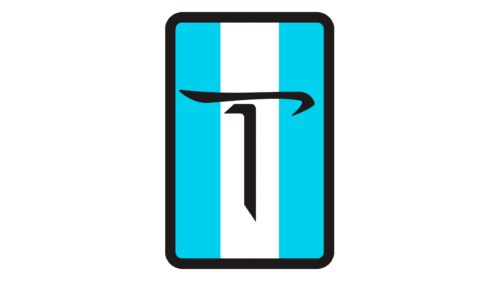
This is the emblem the brand still uses, and it is a deliberate return to the founder’s visual language after the abstract experiment of 2010.
Why there is no separate 2022 redesign
The badge in use traces back to the 2019 revival. Product news from that period, such as the November 2022 announcement of the P900, is a car story rather than a logo story, and small differences in artwork or lettering are not the same as a relaunched corporate mark. On the ownership side, Ideal Team Ventures’ De Tomaso signed a share-purchase agreement with ESGL Holdings, a Nasdaq-listed company, in 2025, so the brand currently sits under ITV with that combination pending.
How to tell the eras apart
Three corporate identities are documented, and they are easy to separate once you know what to look for. The founder-era badge shows the family branding mark inside a blue-and-white field. The c.2010 mark drops that imagery altogether in favour of a monogram of “d” and “t”. The 2019 badge returns to the founder’s “T” with updated proportions while keeping the Argentine colours. Beyond those three, variations that appear on individual cars, dealer signage or regional material are product-level details rather than separate logo designs. For readers tracing the emblems of Italy’s smaller performance marques, the ASA logo is a useful comparison.
FAQ
What does the De Tomaso logo symbolise?
The historic badge combines two references linked to the founder: the light blue and white of the Argentine flag, and the “T”-shaped cattle-branding mark of the Ceballos estate where Alejandro de Tomaso grew up. The 2019 emblem keeps both, updating the letterform rather than the meaning.
Who designed the De Tomaso logo?
No reliable designer credit is documented for the original 1959 badge, which is based on the founder’s family branding mark. The short-lived c.2010 identity was created by New York designer Peter Arnell, and the 2019 revival badge was introduced through the company’s own 60th-anniversary announcement.
When did De Tomaso introduce a new logo?
The company announced a new logo on 15 May 2019, ahead of the P72’s debut at the Goodwood Festival of Speed. An earlier redesign by Peter Arnell was unveiled in August 2010 during the Rossignolo-era revival, but it never appeared on a production car.
Is there a 2022 De Tomaso logo?
The current emblem derives from the 2019 revival identity, and the 2022 news around the brand concerned the P900 model rather than a new corporate mark.
Does De Tomaso still exist as a brand?
Yes. The name is held by Ideal Team Ventures, which acquired the rights in the mid-2010s. In 2025, ITV’s De Tomaso signed a share-purchase agreement with ESGL Holdings, so the brand continues under ITV with that corporate combination still pending.
Disclaimer
This article is part of the educational resources provided by Logo Index, an independent archive covering logos, visual identities and graphic design history. De Tomaso and associated trademarks and brand assets remain the property of their respective rights holders where applicable.