Hudson is an American automobile marque whose identity rests on one of the simplest shapes a badge designer can use: the triangle. The three-sided emblem appeared on radiator shells, grilles and hood ornaments across roughly five decades, and it is the clearest constant in a brand that otherwise changed ownership, model names and styling direction more than once.
The name belonged to Joseph Lowthian Hudson, the Detroit department-store magnate whose J.L. Hudson Company was founded in 1881. He did not own the car company. He supplied capital and allowed the new venture to carry his name. The men who organised the business were Roy D. Chapin and Howard E. Coffin, former Oldsmobile engineers working with a group of Detroit investors, as the Smithsonian’s collection record and the University of Michigan’s Automobile in American Life project both describe. Hudson died in 1912, three years after the company’s first car was delivered.
Meaning and history
Hudson Motor Car Company was organised in Detroit in 1909. Some references give 24 February 1909 as the organisation date; the year itself is the figure the major accounts agree on. The first car, the Hudson Twenty, is usually dated to 3 July 1909, a date that comes from secondary sources rather than a primary record. The young company grew quickly: by 1929 it built roughly 300,000 cars across Hudson and Essex and ranked as the third-largest American automaker. A.E. Barit became president in 1936 and led the firm through its final independent years.
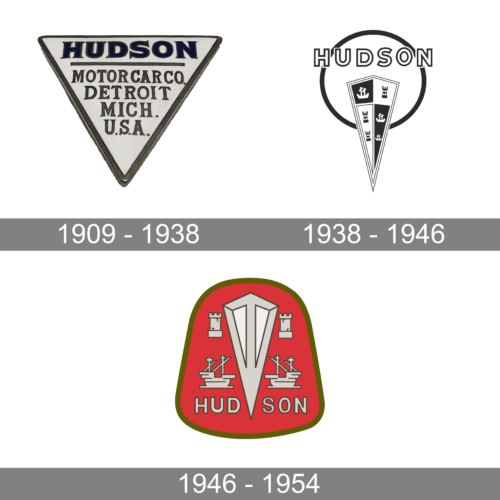
A square collage of assorted Hudson marks circulates online as a history of the brand. It is an editorial assembly rather than a single historical artifact, and its stages are undated, so it works as a visual overview of the emblems discussed below rather than a chronology.
The company’s engineering reputation came later, from the Step-Down body introduced for the 1948 model year and from the Hornet, launched in 1951 and built in 43,666 examples that first year. Hornets won 27 NASCAR races in 1952, 22 in 1953 and 17 in 1954.
In 1954 Hudson merged with Nash-Kelvinator. The boards approved the combination on 14 January 1954, shareholders ratified it on 24 March 1954, and American Motors Corporation took effect on 1 May 1954, as The New York Times reported. The Hudson badge did not end with the merger. The name continued to be marketed through the 1957 model year, and the last Hudson was built on 25 June 1957 in Kenosha, Wisconsin, after production had left Detroit.
The triangular radiator emblem
 Hudson Logo PNG
The earliest Hudson badge was a brass triangle mounted on the radiator, and by the Model 33 of about late 1910 or 1911 a white-enamel triangular version had replaced it, according to the collector reference americanautoemblems.com. Those placements are approximate. The Smithsonian holds a representative example: an inverted triangle reading HUDSON, with MOTOR CAR CO / DETROIT / MICH / U.S.A. arranged in lines beneath. The museum does not date its specimen precisely.
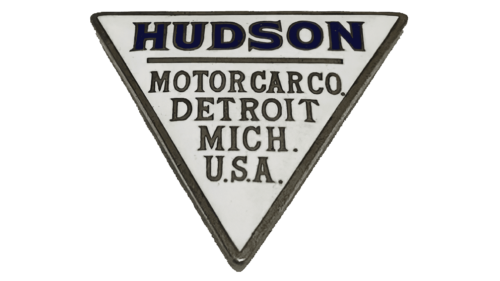
As typography, the emblem is sturdy rather than decorative. The name sits at the top of the triangle in heavy capital letters with flared serifs, and the lines below identify the manufacturer, its city and its country. A border around the edge gives the badge a slight sense of depth. There are no pictorial elements at all: the mark is a word placed inside a shape, which is why it reads clearly at the small scale of a radiator shell.
The triangle as a recurring motif
The triangle was not confined to the company’s first decades. Hemmings, writing about Hudson styling, describes a tradition built on the upside-down triangle that returns in a shield-shaped 1932 grille topped by the triangle, in triangular 6 and 8 badges for 1933, in a crest at the hood and grille junction for 1938, and in the 1956 V-Line styling, which again carried the triangular corporate theme. Chief stylist Frank Spring is credited with the 1932 shield grille and later with the Step-Down cars.
Essex and Terraplane badges
Hudson’s companion makes did not share the triangle. Essex and, from the mid-1930s, Terraplane used hexagonal radiator emblems, a form that shifted to oval Terraplane badges by 1935 and to a design integrated into the hood ornament, an eagle, in the same year. Terraplane was dropped after 1937. The 1933 Hudson 8 radiator ornament is attributed to the sculptor Avard T. Fairbanks in collector references, an attribution that is approximate.
Post-war badging
After the war, Hudson mounted a new Commodore emblem on top of the radiator grille for 1946, a placement that continued through 1949; a red version followed for 1950 to 1954. Collector references are the source for those placements, so the years read as approximate rather than as documented brand standards. A Hudson emblem carrying a crown and the slogan “King of Motor Cars” also circulates in collector photographs, though that source does not establish the emblem’s date or where it was used.
A heraldic emblem and a different Hudson
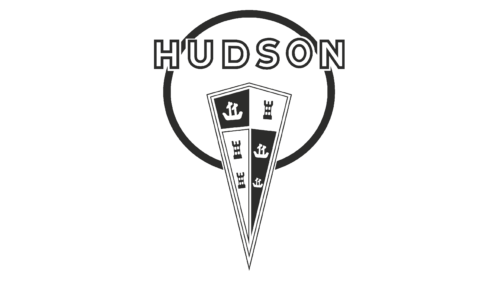
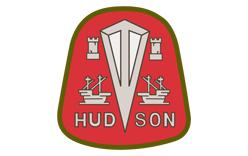
A very different device also appears in material published under the Hudson name: a loop, or key-like form, made of a large black ring with a downward-pointing shield set into it. The shield is divided into a checkerboard and carries a tower and a ship, with HUDSON written across the top in white sans-serif capitals outlined in black. The artwork itself is undated.
No ship, tower, castle or checkerboard-shield emblem appears in the documented emblem corpus of the Hudson Motor Car Company. Specialist catalogues of the marque, including Walt Harris’s Hudson-Essex-Terraplane Mascots, Hood Ornaments and Trademarks (2000, with more than 400 photographs and patent drawings granted to Hudson), describe triangular, hexagonal, oval and ornament-integrated forms. The same motif set, however, is precisely what the J.L. Hudson Company department store claimed as a trademark. USPTO records for the retailer’s design mark give a first use of 1 February 1923, a filing date of 18 December 1923 and a 1924 registration, with design codes covering castles and forts, ships with two and three masts, and shields or crests.
That resemblance places the checkerboard shield with the tower and ship in the department-store brand family rather than in Hudson car identity. The motifs belong to a retail mark from 1923, and the origin of the badge artwork in circulation is not documented.
What the Hudson mark left behind
Hudson’s contribution to American logo design is narrow but durable: an inverted triangle used as a radiator emblem, a grille motif and a corporate sign, with a word inside it doing most of the work. The marque’s emblems and mascots are now catalogued mainly through club and collector literature and through museum holdings such as the Smithsonian’s radiator badge, which keeps the earliest form of the mark in the public record. Hudson cars stopped being built in 1957, but the three-sided shape is what most people still recognise as the Hudson logo.
FAQ
Why was the Hudson logo a triangle?
The inverted triangle served as Hudson’s recurring corporate motif. It appeared on radiator emblems from the earliest cars and returned in the 1932 shield grille, the triangular 6 and 8 badges of 1933 and the 1956 V-Line styling, a pattern documented by Hemmings in its coverage of Hudson design.
Was Hudson owned by Joseph L. Hudson?
No. Joseph Lowthian Hudson was a Detroit department-store magnate who financed the young company and allowed it to use his name. The business itself was organised in 1909 by Roy D. Chapin and Howard E. Coffin, both former Oldsmobile engineers, with a group of Detroit investors.
Did Hudson cars ever use a ship-and-tower emblem?
Not in the documented car emblem corpus, which covers triangular, hexagonal, oval and hood-ornament-integrated forms. The castle, ship and checkerboard-shield motifs match the J.L. Hudson Company department store’s trademark, which records a first use of 1 February 1923.
Disclaimer
This article is part of the educational resources provided by Logo Index, an independent archive covering logos, visual identities and graphic design history. Hudson and associated trademarks and brand assets remain the property of their respective rights holders where applicable.