Koenigsegg Automotive AB is a Swedish maker of hand-built hypercars based at Ängelholm, in the southern province of Skåne. The company was founded in 1994 by Christian von Koenigsegg, who was 22 at the time. The brand name is simply his surname, and its main emblem comes from the same source: the von Koenigsegg family coat of arms.
 Koenigsegg Logo PNG
The badge was designed in 1994 by the Swedish graphic designer Jacob Låftman, who based it on that coat of arms. Koenigsegg’s Wikipedia entry credits Låftman with the 1994 design, while a Finnish-language entry dates it to 1993. The badge therefore belongs to the company’s founding period, though the exact year is not settled.
The arms behind it are far older than the car company. The family was ennobled under the Holy Roman Empire, and the Königsegg line is traced to Swabia; heraldic references describe the arms as being in use since the twelfth century, after a member of the family was knighted. The shield’s lower field carries a diagonal arrangement of red and gold rhombi, drawn so that the surface appears faceted and three-dimensional rather than flat.
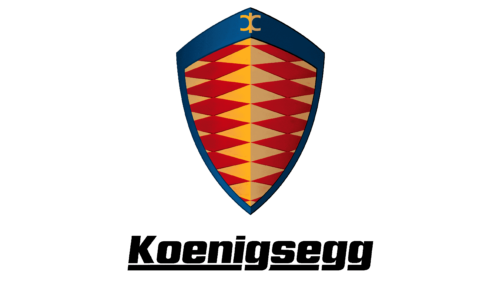
The full lockup pairs the shield with the Koenigsegg name. The wordmark is a bold, technical sans-serif, and in most versions it sits above or beside the crest, with the lettering kept plain so that the heraldry stays the focal point. The typeface itself is not documented publicly; a brand guidelines overview notes that the exact type used for the nameplate is unverified.
The design also has a wider peculiarity: few car badges are literal coats of arms. This one carries no animal, no letterform and no speed motif, just a shield, a geometric field and the founder’s surname set in plain sans-serif.
Across three decades the crest has changed very little. The documented stages are the founding badge of the mid-1990s, the addition of a second emblem in the 2000s, and a broader corporate identity update in the late 2010s.
The ghost badge
On 22 February 2003 a fire destroyed the factory at Margretetorp, and Koenigsegg relocated to a former Swedish Air Force base at Ängelholm. That base had been home to the F 10 wing, whose unit was nicknamed the Ghost Squadron and carried the official designation Johan Röd; its motto was “The Show Must Go On”. Koenigsegg took the squadron’s ghost as a tribute, and the figure has appeared on its cars since, generally reported from the CCR onwards.
The timing lines up with the company’s move from prototype to series production. The first CC prototype was completed in 1996 and shown at Cannes in 1997, followed by the Paris Motor Show in 2000. The first production car, the CC8S, was delivered at the 2002 Geneva Motor Show, with six examples built.
The ghost is a separate mark from the crest. It is not part of the corporate logo lockup in the way the shield is; it lives on the cars as an emblem and as a piece of company history, which is why the two are often discussed together despite coming from unrelated sources.
The 2019 identity update
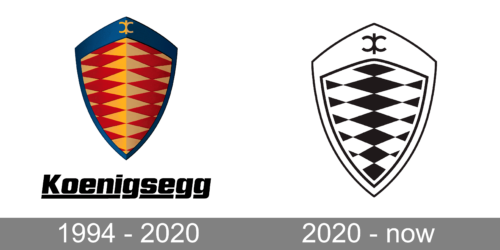
The most substantial documented change to the identity came around 2019, when the Stockholm studio J.design produced a corporate identity programme for the company, described as arriving roughly 25 years after the founding. It included a new logotype, a new symbol, a bespoke typeface and a graphic pattern, applied both in communications and on the cars. J.design’s project page is the clearest account of the work. Some later summaries place a logo change in 2022; the available sources do not support that date.
Alongside the colour version, monochrome crests have become common on recent cars, rendered in black or white depending on the bodywork. The point at which that variant was introduced is not well documented.
Colour and use
In colour, the crest keeps the heraldic red and gold of the family arms, a pairing that stays legible at small sizes and in cast metal. Specific colour values are not widely published.
The two marks divide the work. The crest and wordmark carry the corporate identity, while the ghost appears as a secondary emblem on the cars. Neither has been replaced in recent years, and the founding shield remains the version most people picture when they think of Koenigsegg.
Disclaimer
This article is part of the educational resources provided by Logo Index, an independent archive covering logos, visual identities and graphic design history. Koenigsegg and associated trademarks and brand assets remain the property of their respective rights holders where applicable.