The Oakland Motor Car Company was organized in Pontiac, Michigan, in 1907 by Edward M. Murphy, a carriage builder whose Pontiac Buggy Company supplied its manufacturing base. The car itself was designed by Alanson P. Brush, the engineer behind the original single-cylinder Cadillac, who served as Oakland’s vice president and chief engineer. General Motors took a half interest in 1909; the GM board, then working under William C. Durant, authorized the purchase on January 20 of that year, and the completed transaction is dated to January by some sources and to April by others. GM gained full control after Murphy died that summer. Sinsabaugh’s 1940 history of the American industry records the founding and the GM negotiations.
 Oakland Logo PNG
The brand took its name from Oakland County, Michigan, not from the tree. Its most enduring visual device was botanical all the same: a cluster of oak leaves and an acorn, used on radiator badges across several model generations. That motif visually echoes the county name, though surviving records do not document a formal rationale for it, and no reliable designer credit for the emblem artwork is documented.
Early radiator badges
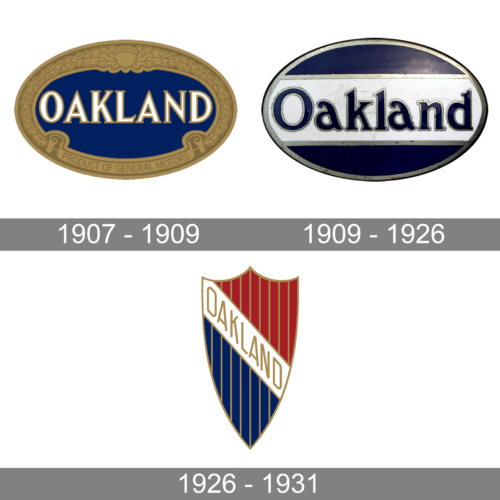
Oakland’s earliest cars carried the name as a brass radiator script, and four-cylinder models also wore an oak-leaf and acorn emblem in the same material. Bonhams cataloguing of a 1916 Model 38 describes the oak-leaf and acorn radiator badge as a defining feature of the cars, alongside period marketing lines such as “The Car With A Conscience.”
Collector badge references trace a rough sequence through this period: a brass oak-leaf and acorn cluster in the years around 1909 to 1911, a single oak-leaf and acorn enamel badge for 1912, and then no radiator emblem at all from roughly 1913 to 1916. Those placements come from specialist emblem catalogues rather than from company records, so they describe surviving hardware more precisely than they describe a planned design schedule.
The blue-and-white oval
By about 1916 the radiator badge had reappeared as an enamel oval in blue and white. A redrawn version of that oval, combining the acorn and oak leaves with the Oakland lettering, is associated with the 1924 Model 6-54 and carried over to the Greater Six and All-American models of 1926 to 1928. The same era produced the advertising line “True Blue Oakland,” tied to a dark blue lacquer finish. H&H’s listing for a 1918 Oakland Model 34B roadster records the period slogan “The Right Car at the Right Time.”
The later radiator emblems
The best documented individual Oakland badge is an oval radiator emblem catalogued to about 1925 and held by The Henry Ford. It is a die-cast cloisonné piece in zinc alloy and brass with enamel in gold, blue and white, measuring roughly 1.875 by 3.125 inches, made by the D. L. Auld Company of Columbus, Ohio. Its design is an oak-leaf wreath topped by an acorn, with a banner reading “PRODUCT OF GENERAL MOTORS.” A separate Oakland radiator emblem in the Smithsonian’s collection is shield shaped, with red and blue stripes and a white banner carrying the name in gold lettering.
The General Motors wording on the later badge reflects the corporate ownership that began in 1909, which means emblems carrying GM branding belong to the 1910s and 1920s rather than to Oakland’s first two years as an independent company. The two surviving objects are also distinct badges from different periods, not stages of one continuous mark.
The end of the marque
Oakland’s companion make, Pontiac, was introduced for the 1926 model year, with production beginning in late December 1925, and it quickly outsold its parent. Pontiac’s first-year sales are commonly reported at roughly 76,000 cars, though published figures vary. Oakland production ended in October 1931, and the division was reorganized under the Pontiac name, a change dated to 1931 by some sources and 1932 by others. Archived histories of the company follow the marque through that transition, and the Oakland radiator badge went out of use with it.
FAQ
Is the Oakland logo connected to Oakland County, Michigan?
The company took its name from Oakland County, and the oak-leaf and acorn motif on its radiator badges visually echoes that name. Surviving records do not document a formal design rationale for the emblem, so the connection between the county and the badge artwork is suggestive rather than stated by any source.
When did Oakland stop using its own emblem?
Oakland production ended in October 1931, and the division was reorganized as Pontiac, which already had its own radiator badge. From that point the Oakland emblem was no longer used on new cars.
Disclaimer
This article is part of the educational resources provided by Logo Index, an independent archive covering logos, visual identities and graphic design history. Oakland and associated trademarks and brand assets remain the property of their respective rights holders where applicable.