Monte-Carlo Automobiles is the public identity of a small Monaco car manufacturer registered as Monte-Carlo Automobiles S.A.R.L. Its works sit in the Fontvieille industrial district, the quarter that has housed several of the principality’s specialist builders. The company was founded by Fulvio Maria Ballabio, an Italian engineer and racing driver whose career ran through Formula 3, Formula 3000, IndyCar, Le Mans prototypes and offshore powerboats. The founding date is not settled: most accounts give 1983, Ballabio himself told Nice-Matin the company began in 1982, and other chronicles place the start of serious car building in 1985.
 Monte-Carlo Automobiles Logo PNG
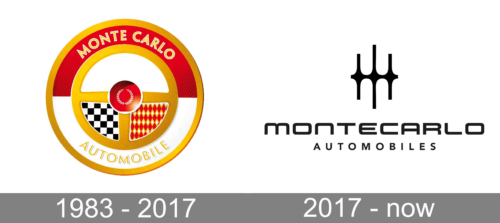
The design history of the marque’s emblem is thinly documented. No designer, studio or typeface is credited in the sources that cover the company, and the Monaco trademark journal indexes records for the Automobile Club de Monaco rather than a Monte-Carlo Automobiles logo mark. Because there is no settled account of the badge’s authorship or its colour rationale, the most reliable way to read any surviving MCA artwork is through the company’s naming record, which is where the identity actually changed and can be dated. Small specialist builders often leave exactly this kind of uneven paper trail; our profile of the Turcat-Méry logo shows a comparable case of a badge outliving the design record that produced it.
Name changes as the real identity thread
The clearest documented thread in MCA’s visual identity is a sequence of corporate names catalogued on German Wikipedia. The marque traded as Monte Carlo Automobile from 1990 to 1993, then as MIG (Migrelia & Georgia) in 1993 and 1994, then returned to Monte Carlo Automobile and later Monte Carlo Automotive Group between 2009 and 2021, before adopting Monte-Carlo Automobiles S.A.R.L. from 2021. Each of those changes alters what any wordmark on a car, a document or a workshop sign would have read, which makes the name chronology the most useful tool for placing undated artwork. An earlier motorsport operation ran under the separate names Monte Carlo Motorsport and Écurie Monaco.
A second documented thread is the brand’s habit of importing Monaco’s motoring heritage into its naming. The best-known product, the Centenaire, was presented in 1990 and tied to the centenary of the Automobile Club de Monaco, founded in 1890. One account dates the Monaco debut to 25 May 1990 at the Hôtel de Paris, though that precise day rests on a single source. Production was planned at 100 units and roughly five were built. In 1993 a Centenaire V12 won its class at the 6 Hours of Vallelunga, while two cars renamed MIG 100 failed to qualify for the 24 Hours of Le Mans.
Ownership changes and later model names
Ownership passed to the French Aixam-Mega group in the mid-1990s. Sources disagree on the year, splitting between a 1994 asset acquisition, 1995 and a 1996 Geneva presentation of the Mega Monte Carlo, so no single date can be stated confidently; the programme was later abandoned and the rights returned to the founder, as recounted by Carjager. Model names continued to carry Monegasque references. The ALA 50 of May 2008, or Albert Anniversaire 50, marked Prince Albert II’s 50th birthday and MCA’s 25th anniversary, a pairing that also corroborates a 1983 founding. The BRC W12 finished eighth overall at the 4 Hours of Monza on 25 March 2012, and the Rascasse, a BMW-sourced 5.4-litre V12 car, is dated 2014 by some sources and 2013 by others.
February 2017 brought the world premiere of the Tecno MonteCarlo W12 GPL at SIAM Monaco, staged from 16 to 19 February, according to the show organiser’s release. Ballabio was described at the time as an engineer and consultant to Tecno Monte Carlo Motors, an England-based venture emerging from a link between MCA and Tecno. That date belongs to a product and corporate event, not to a recorded badge redesign.
Trademark records and what they cover
One registration often associated with the name is not the marque’s own. A Madrid system record for the word mark MONTE-CARLO 2012, registration G1166690, lists S.A.M. Marques de l’État de Monaco (Monaco Brands) as holder, covers classes 1201 to 1210, and records a cancellation in November 2023, as shown in the published record. That filing belongs to the Monaco state brand office and does not establish ownership of Monte-Carlo Automobiles’ emblem. The distinction matters when tracing the badge: a Monegasque word mark and a carmaker’s own logo are different assets, held by different parties.
For anyone dating a piece of MCA artwork, the practical anchors are therefore narrow but usable. A car or document marked Monte Carlo Automobile points to 1990 to 1993 or to the later 2009 to 2021 period; MIG belongs to 1993 and 1994; and the S.A.R.L. wording indicates 2021 or later. The marque built a modest number of cars over four decades, around fifty by Ballabio’s own estimate, which is one reason its emblems appear rarely in public and why the naming chronology, rather than a documented design programme, remains the best guide to what any given badge represents.
Disclaimer
This article is part of the educational resources provided by Logo Index, an independent archive covering logos, visual identities and graphic design history. Monte-Carlo Automobiles and associated trademarks and brand assets remain the property of their respective rights holders where applicable.