Nash Motors was an American automaker based in Kenosha, Wisconsin. It was founded in 1916, when Charles W. Nash, a former president of General Motors, left Detroit and bought the Thomas B. Jeffery Company, the Kenosha firm that had been building Rambler and Jeffery cars since 1902. Nash sold mid-priced automobiles and, for most of its life, ranked among the stronger independents outside the Big Three. Its identity survives largely in metal: a long run of radiator emblems that carried the Nash name from the late 1910s until the late 1950s.
 Nash Motors Logo PNG
Nash Motors logo history
The first Nash emblem appeared on cars that were still, in effect, Jeffery products. Specialists who catalogue radiator badges date the earliest Nash badge to around mid-1917, when the Kenosha plant began fitting Nash nameplates to re-badged Jeffery models as the older brand was retired. The badge survives mainly in collector and museum records, so its introduction date is approximate rather than documented to the month, according to the American Auto Emblems chronology of Nash radiator badges.
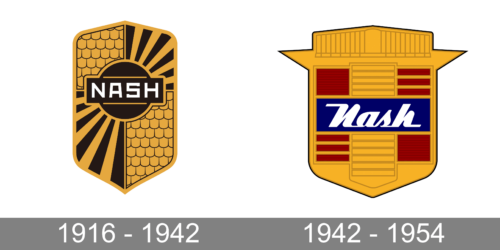
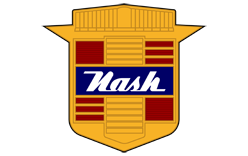
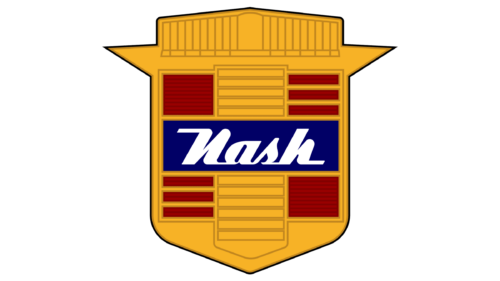
The fullest description of a Nash emblem comes from a museum object rather than a corporate document. The Smithsonian’s National Museum of American History catalogues a shield-shaped radiator emblem divided into quarters, with gold scales in the first and fourth quarters, golden rays in the second and third, and the word Nash at the centre. The museum dates the piece to the 1920s and 1930s. That combination of scale and ray patterning around a centred wordmark is the most recognisable thread running through Nash badge design.
Materials and finishes changed far more often than the underlying idea. Blue and white enamel emblems appeared around 1920; badges were plain metal for several seasons in the early 1920s; black enamel returned in about 1924 and was reworked a couple of years later. From roughly June 1928, Nash fitted a black-and-white enamel radiator emblem with a “fishscale” pattern to Series 400 and 600 cars, followed by a smaller version in 1931 and v-shaped badges from late 1933. Shapes also tracked the grille: rectangular, v-shaped and winged variants all appear across the period.
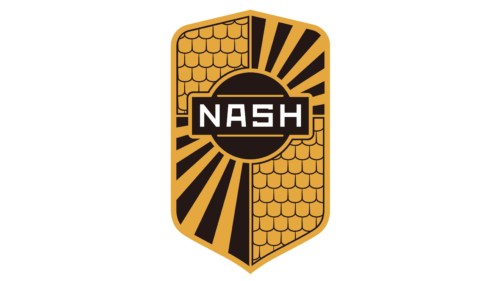
Early Nash badge artwork is widely reproduced, though the years attached to individual pieces are frequently approximate, and the surviving images should be read as a sequence of related designs rather than one fixed mark. The documented run begins in the late 1910s and evolves steadily through the 1930s.
From independent badge to division mark
In January 1937, Nash merged with Kelvinator to create Nash-Kelvinator Corporation, a deal in which the appliance maker’s controlling interest was the condition set by George W. Mason for taking the top job at Nash, as recorded in the company’s corporate history. From that point Nash was the automotive division of a larger corporation, and the emblems on its cars were division marks rather than the badge of an independent carmaker.
The postwar cars put those badges on some of the most distinctive American shapes of the era, from the aerodynamic Airflyte of the late 1940s to the compact Rambler introduced around 1950. Nash styling of this period is sometimes credited to outside design consultants, including the 1957 Ambassador, which is described as Pinin Farina-styled in Hemmings coverage of the period. Those credits concern the cars themselves; the emblems they carried are documented mainly through badge and museum records.
The end of the Nash marque came through consolidation rather than failure. In 1954, Nash-Kelvinator merged with Hudson Motor Car Company to form American Motors Corporation, and the Nash brand continued on AMC cars for a few more seasons before being retired after the 1957 model year, as The Henry Ford collection notes. After that, Rambler became the company’s marque.
Meaning behind the Nash emblem
The scales and rays are consistently described in museum records, but no company statement or reliable source explains what they were intended to signify. Published interpretations that attach ideas such as power, luxury or flight to the Nash badge are not supported by company documents or museum cataloguing. What is documented is the structure: a quartered shield, repeating scale and ray motifs, and the Nash wordmark holding the centre.
FAQ
Who designed the Nash Motors emblem?
Available records do not name a designer, studio or agency behind the Nash radiator emblem. The badge is documented mainly through museum object records and specialist emblem catalogues rather than through design credits, and the styling credits associated with Nash cars apply to the vehicles, not to the emblem itself.
Disclaimer
This article is part of the educational resources provided by Logo Index, an independent archive covering logos, visual identities and graphic design history. Nash Motors and associated trademarks and brand assets remain the property of their respective rights holders where applicable.