 20th Century Fox Logo PNG
Meaning and history
The 20th Century Fox logo pairs a stepped, three-tier monolith with a searchlit sky. Its stacked lettering and architectural form give the mark a distinctive Art Deco appearance. The original monolith was painted by Emil Kosa Jr. in 1933 for Twentieth Century Pictures; after that company merged with Fox Film Corporation in 1935, “Pictures, Inc.” was replaced with “Fox,” as The Hollywood Reporter recounts.
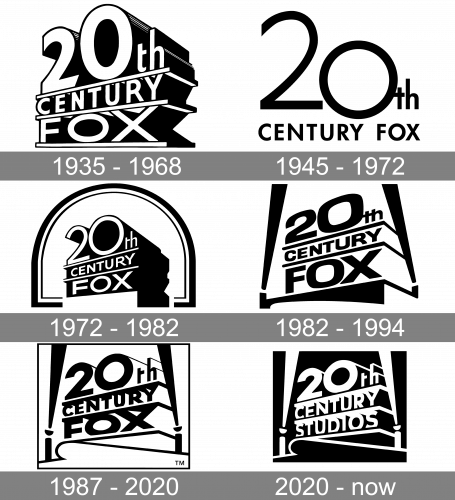
The logo’s familiar screen presentation developed through changes to its lettering, framing and animation. Searchlights vary across versions; a history by Süddeutsche Zeitung describes versions with as many as seven beams. The fanfare is another longstanding part of the theatrical identity.
1935 – 1968

The first Fox version kept Kosa’s stepped structure and changed the lower tier’s wording to “Fox.” The 1935 merger established the name Twentieth Century-Fox, while the logo’s central idea remained the dimensional monolith. In 1953, Rocky Longo of Pacific Title repainted the mark for CinemaScope and tilted the zero in “20th” for the wider frame. Longo straightened it again in 1981, according to Creative Bloq.
1945 – 1972
This stage represents a simplified treatment of the lettering. Compared with the dimensional monolith and searchlit setting, the reduced wordmark puts more emphasis on the words themselves. It shows how the studio identity could be adapted for uses that did not require the full screen presentation.
1972 – 1982

The identity returned to a tiered arrangement, with the lettering set within a framed, arched form. That structure keeps the stacked wordmark prominent while giving it a different outline from the earlier open monolith. Creative Bloq’s history covers the period’s print treatments and the wider evolution of the mark.
1982 – 1994

Searchlights and a dark ground feature in this stage’s print treatment, bringing the theatrical lighting motif into a compact graphic composition. The stage label spans a broad period, but the dating of particular print variants is not precise enough to assign this appearance to a specific year.
1987 – 2020

The familiar dimensional lettering and searchlights continued into the computer-animated era. In 1994, the studio introduced a 21-second CGI opener with a view of the Los Angeles basin, the Hollywood sign and an “A News Corporation Company” byline. Fox-owned Blue Sky Studios refreshed the logo in 2009; both changes are described by The Hollywood Reporter.
2020 – Today
In January 2020, the studio became 20th Century Studios. The rebrand kept the stacked monolith and searchlight identity while changing the bottom line from “Fox” to “Studios.” Picturemill animated the new version, which debuted on screen with The Call of the Wild on February 21, 2020, as The Hollywood Reporter reported. The Walt Disney Company completed its acquisition of 21st Century Fox in March 2019, before the rename; Variety’s merger timeline distinguishes the deal’s 2017 announcement from its completion.
Lettering, color and sound
The mark’s defining features are its large “20th,” the stacked “Century” and “Fox” or “Studios,” and the stepped structure that frames them. In the screen versions, warm gold lettering stands against a sky or sunset, with searchlights sweeping around the monolith. Print treatments can simplify the scene or place the structure against a dark ground. Filmmakers have also made film-specific variations, including a snow-dusted monolith for Edward Scissorhands, as The Hollywood Reporter notes.
Alfred Newman’s fanfare accompanied the studio’s screen identity from 1935 to 1953 and was later reused for Star Wars in 1977. For the 1994 CGI opener, Bruce Broughton arranged the music; David Newman re-recorded it in 1997 and 1998, according to Süddeutsche Zeitung and The Hollywood Reporter.
Disclaimer
This article is part of the educational resources provided by Logo Index, an independent archive covering logos, visual identities and graphic design history. 20th Century Fox and associated trademarks and brand assets remain the property of their respective rights holders where applicable.