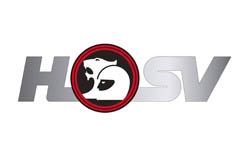
HSV is the short form of Holden Special Vehicles, the Australian performance operation that turned Holden donors into ClubSport, GTS, Maloo, Senator and Grange models. Its public identity is built on one image: a lion paired with a racing helmet, usually shown with the three letters HSV.
 HSV Logo PNG
The company itself is often described as a Holden division, which overstates the relationship. HSV was formed in July 1987 as a joint venture between GM Holden and Tom Walkinshaw Racing, created after Holden ended its association with Peter Brock’s Holden Dealer Team. The business opened publicly in February 1988 and released its first production model, the VL Group A SS, that March. According to HSV’s official history, the arrangement separated Holden’s performance engineering from Holden itself, and the brand kept that independent structure for three decades. By the time Commodore-based production finished in 2017, GoAuto reported a total of 90,114 vehicles built. That outside-partner status matters for reading the badge: the emblem never had to carry the full Holden identity, only to sit beside it.
What the Lion and Helmet emblem shows
The core emblem is a circular badge containing a lion and a racing helmet, ringed in red, with the HSV letters locked to it. A physical dealership sign listed at auction is described as showing a lion head and racing helmet encircled in red, with HSV in white beneath, which matches the form seen on vehicles and printed artwork. Private Fleet describes the marque logo simply as the combination of the heraldic lion’s head and the racing helmet, and notes its resemblance to the Holden Racing Team mark.
The lion is the more legible symbol. Holden’s long-running lion and stone emblem, drawn in 1928 by the sculptor Rayner Hoff, made the animal a recognised part of the parent brand’s heritage, so a lion on the HSV badge reads naturally as a link back to Holden. The helmet points the other way, towards motorsport. V8 Sleuth traces the “silhouette lion and helmet” idea to a race-car sketch rather than to a marketing brief. Beyond those two readings, published explanations of individual elements are thin, and it is better to leave the symbolism at that level than to invent meaning for the colours or the proportions of the helmet.
The emblem’s introduction date sits at the boundary between the company’s founding and its first car. HSV dates from July 1987, opened publicly in February 1988, and shipped its first model in March 1988, so the identity work belongs to that window. A tertiary logo-history site dates the helmeted lion identity to 1987, but it offers no primary citation, and the 1988 date sometimes attached to the badge is not fixed by any authoritative source either. Treat the mark as dating to roughly 1987 to 1988.
Who designed the HSV badge?
Designer credit is genuinely unresolved, and the two published accounts do not agree. V8 Sleuth credits the original Holden Special Vehicles helmet and lion logo to the English corporate identity group Wolff Olins. A separate first-hand account published by Primotipo describes HSV managing director John Crennan briefing the Melbourne agency Flett, Henderson Arnold to develop the HSV logo and a brand manual, with Richard Henderson leading a small team that produced a range of options. Neither claim is backed by a primary document, and no source reconciles them. It is possible that one firm originated the symbol and the other localised and documented it, but that reading has no supporting evidence, so neither agency can be named as the definitive designer.
The 2018 badge refresh
HSV’s identity was stable for a long time, but the badge was not frozen. In 2018 the company introduced a redesigned emblem on the Holden Colorado SportsCat by HSV, launched that February. HSV described it as a contemporary interpretation of the Lion and Helmet badge, and The West Australian noted that the SportsCat was the first vehicle to wear it. The change came as HSV shifted from building locally manufactured Holdens to enhancing and converting imported GM vehicles, so the refreshed mark accompanied a real change in what the company did rather than a cosmetic tweak. Before that redesign, Drive had observed that the brand had not changed its logo since its inception roughly thirty years earlier, which makes the 2018 update the first documented revision of the Lion and Helmet.
Badge, wordmark and applied versions
HSV artwork survives in more than one form. Alongside the circular lion-and-helmet emblem there is a horizontal HSV wordmark lockup, and separately a badge or sticker treatment in which the letters and the emblem are combined into a single applied unit. These are visible design states rather than documented product stages, and the surviving artwork carries no reliable date, so they are best described as the logo’s print and applied variants rather than tied to specific model years. On vehicles the emblem appears as a metallic, three-dimensional badge, which is a manufacturing treatment of the same mark rather than a different logo.
Typography is the weakest part of the public record. No authoritative identity guideline was located for HSV, so claims about a specific exclusive typeface, or a particular commercial font used as a reference, are not supportable and are omitted here. The wordmark’s defining visual trait is its compact, heavy, italicised construction with the letters tightly spaced, but that description comes from the artwork itself, not from a published standard.
A separate mark: the Holden Racing Team livery
Because the HSV badge and the Holden Racing Team identity share a rampant lion with a racing helmet, the two are frequently confused. They are related but distinct. The HRT race livery ran from 1989 to 1995 and was sketched by Holden chief designer Mike Simcoe, according to V8 Sleuth. HSV’s road-car emblem is described as a variation on that shared lion-and-helmet graphic, but it is the corporate badge of the vehicle business, not the racing team’s livery. Treating the HRT livery as the HSV logo, or the reverse, misreads both.
Reading the mark today
HSV’s own vehicle-building era ended when Commodore-based production stopped in 2017, and the brand moved to converting imported GM products. After General Motors retired Holden in 2020, GM Specialty Vehicles took over distribution of GM products in Australia, while HSV’s parent, Walkinshaw Automotive Group, continued its own operations. The Lion and Helmet badge remains the clearest single identifier the company produced, and its durability is unusual for a performance sub-brand that was never fully owned by the manufacturer whose lion it carried.
FAQ
Is HSV the same company as Holden?
No. HSV was a joint venture between GM Holden and Tom Walkinshaw Racing, formed in 1987 and historically held through Premoso Pty Ltd. It built high-performance vehicles based on Holden models, but it operated as a separate business rather than a Holden division.
What does the HSV logo represent?
The lion connects the badge to Holden’s established lion heritage, while the racing helmet signals the company’s motorsport-focused performance work. Together they present HSV as a Holden-linked racing brand rather than a standalone one.
When did HSV change its logo?
HSV introduced a redesigned Lion and Helmet badge in 2018, described by the company as a contemporary interpretation of the original. The Holden Colorado SportsCat by HSV was the first vehicle to wear it.
Disclaimer
This article is part of the educational resources provided by Logo Index, an independent archive covering logos, visual identities and graphic design history. HSV and associated trademarks and brand assets remain the property of their respective rights holders where applicable.