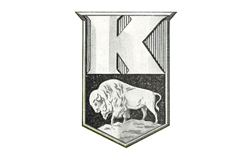
Kaiser was the automobile marque of the Kaiser-Frazer Corporation, the American manufacturer formed in 1945 by industrialist Henry J. Kaiser and Joseph W. Frazer, a former president of Graham-Paige. The two men launched companion makes, the medium-priced Kaiser and the upper-priced Frazer, as 1947 models after showing prototypes at New York’s Waldorf-Astoria in January 1946, and built them mainly at Willow Run, Michigan, in a former Ford bomber plant (Wikipedia). The marque’s best-known visual identifier is a shield carrying the letter K above a bison.
 Kaiser Logo PNG
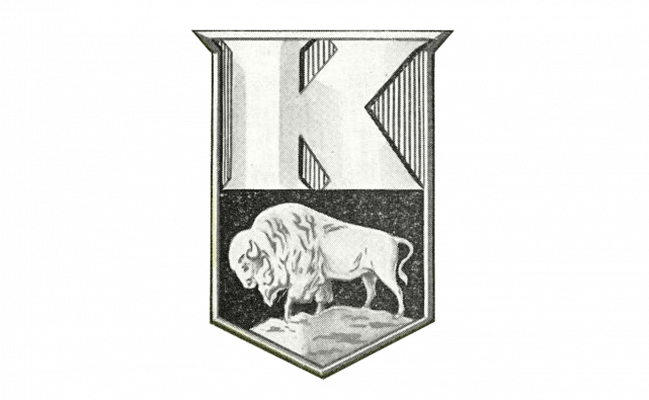
The K and bison shield
The earliest Kaiser badge held in museum collections is a shield-shaped radiator and hood emblem with the letter K above a bison. The Henry Ford’s catalogue entry for a 1950 example describes exactly that arrangement and records a black, green and silver palette, noting that the piece was made for Kaiser-Frazer by the American Emblem Company of Utica, New York. The Smithsonian’s National Museum of American History describes the same device as “the letter K above a buffalo inside a shield.” Chrome script lettering spelling the brand name appeared alongside it. Within the corporate family, Mac’s Motor City Garage records that the Kaiser badge was the K device while the companion Frazer marque used a crest (Mac’s Motor City Garage).
Collector references document a sequence of adjustments to that basic shield. On the first cars it was large and mounted on the hood above a chrome “Kaiser” script; by 1949 to 1950 it had been reduced in size and moved lower toward the grille, with the detail painted rather than enameled; for 1951 it shrank again and the bison was rendered in relief (americanautoemblems.com, corroborated by radiatoremblems.com). That staging comes from enthusiast cataloguing rather than company records, so the years are approximate rather than a firm release schedule. The animal itself has no documented symbolic meaning; the familiar reading of the bison as power and stability traces to collector discussion rather than to any Kaiser-Frazer statement.
The K-in-V badge of 1952 and 1953
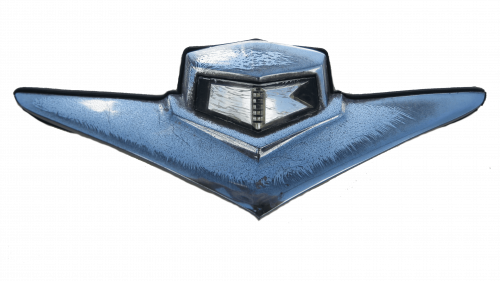
Around 1952 the design changed completely. A plastic K was set into a sharply pointed chrome V on the hood, with a matching piece on the trunk lid. Enthusiast documentation holds that the V originally signalled an intended V8 engine that never reached production, with the planned numeral changed to a K (kaiserbill.com). The exact redesign year is not established in company material.
Script badges and the 1954 to 1955 Manhattan
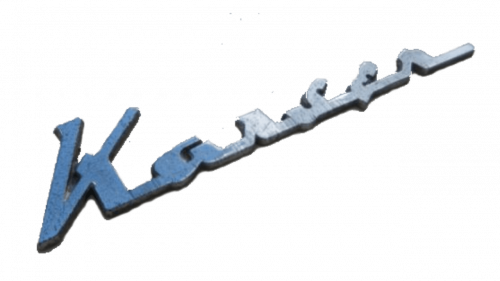
By 1954 the hood emblem had been dropped. The 1954 and 1955 Kaiser Manhattan kept a trunk emblem and relied instead on script: “Kaiser” on the hood front and trunk lid, and “Kaiser Manhattan” along the body sides (americanautoemblems.com). The Manhattan nameplate itself predates 1954, having appeared earlier in the Frazer line and on Kaiser cars, so 1954 marked a restyle with supercharging rather than the model’s debut. That car used a McCulloch VS57 supercharger on a 226 cubic inch inline-six rated at roughly 140 horsepower (Bring a Trailer), and Autoweek dates the supercharged version’s introduction to February 1954 (Autoweek). The 1954 Kaiser Darrin roadster, a fiberglass two-seater, carried its own front-end treatment without a hood emblem; about 435 were built.
Font and color
Kaiser badges were die-cast metal, chrome-plated and finished with enamel or cloisonné-style detail, so the emblem carried both relief and flat color. The documented palette of the shield is black, green and silver. No typeface is credited for the script wordmarks, and no individual designer or outside agency is recorded for the K and bison device; the only creator named in museum records is its manufacturer, the American Emblem Company.
Later history
The company was renamed Kaiser Motors Corporation in 1953 by stockholder vote, took on the assets of Willys-Overland that same year under the name Willys Motors, Inc., and ended U.S. Kaiser passenger-car production with the 1955 model year (Wikipedia). Roughly 760,000 Kaiser and Frazer cars were built in the United States between 1946 and 1955. The business later became Kaiser Jeep and was sold to American Motors in 1970, which ties the marque to AMC’s own emblem history. Kaiser-badged cars continued to be built overseas into the 1960s, including the Argentine Kaiser Carabela.
FAQ
Did Kaiser use more than one logo?
Yes. The K and bison shield was refined repeatedly between the late 1940s and 1951, then replaced around 1952 by a plastic K set in a chrome V, and finally by script-only badging on the 1954 and 1955 Manhattan. The marque therefore has several documented emblem stages rather than a single unchanged mark.
What did the Kaiser emblem look like?
The core design was a shield with the letter K at the top and a bison below, produced in black, green and silver by the American Emblem Company. Later cars used a chrome K-in-V badge or simply chrome script reading Kaiser or Kaiser Manhattan.
Disclaimer
This article is part of the educational resources provided by Logo Index, an independent archive covering logos, visual identities and graphic design history. Kaiser and associated trademarks and brand assets remain the property of their respective rights holders where applicable.