 Ascari Logo PNG
The Ascari logo connects a British sports-car manufacturer with one of Italy’s greatest racing drivers. Ascari Cars took its name from Alberto Ascari, Ferrari driver and Formula One World Champion in 1952 and 1953.
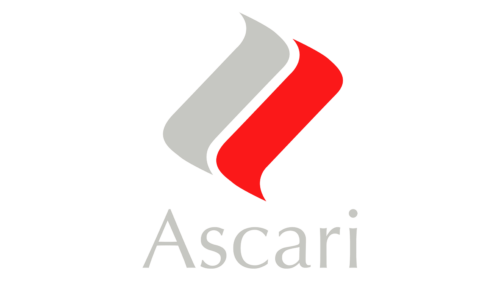
The marque’s emblem reinforces that connection visually. Period automotive coverage described the distinctive red-and-gray graphic as a stylized representation of a waving Italian flag, giving the British-built cars an explicit link to the Italian racing heritage behind the Ascari name.
Ascari Logo Meaning and History
The Ascari identity is built around two elements:
- the Ascari name, taken from racing driver Alberto Ascari;
- an abstract curved emblem associated with the colors and movement of the Italian flag.
A 2001 history of the marque described the symbol as a stylized depiction of a waving Italian flag, despite Ascari itself being a British manufacturer. [1]
This documented connection is more useful than interpreting every part of the logo as representing speed, precision, exclusivity or luxury.
Why Is the Brand Called Ascari?
The company was named in honor of Alberto Ascari, one of the leading Grand Prix drivers of the early 1950s.
Ascari won consecutive Formula One World Championships for Ferrari in 1952 and 1953. He remains particularly associated with Ferrari and Italian motorsport history.
By adopting his surname, the British sports-car project immediately linked its identity with racing rather than with its founder’s own name.
The connection is therefore deliberate and historical, not merely an interpretation added to the logo later.
The Flag-Like Ascari Emblem
The Ascari symbol is highly abstract. It uses two flowing, vertically arranged forms rather than a conventional shield, animal or monogram.
Period reporting described these shapes as a stylized Italian flag moving in the wind. [1]
The mark can consequently be understood as reinforcing the Italian association already established through Alberto Ascari’s name.
This does not mean that every curve has a separately documented meaning. Claims that the shapes specifically represent acceleration, precision or aerodynamics are not supported by an original design explanation located for this article.
Ascari Logo Colors
Surviving Ascari branding uses a combination of red, gray or silver, black and white, depending on whether the mark appears digitally, in print or as a physical vehicle badge.
A 2007 photograph of an original badge mounted on an Ascari KZ1 confirms the physical use of the emblem on the company’s cars. [2]
The original Ascari website also supplied the logo artwork used to create the widely preserved vector version of the mark. [3]
No reliable company source located for this article assigns generic psychological meanings such as red representing passion, black representing power or silver representing precision. Those claims should therefore be omitted.
Ascari Wordmark
The ASCARI name has appeared alongside the graphic emblem in restrained uppercase lettering.
The visual emphasis falls primarily on the unusual flag-like symbol and the relatively short six-letter name rather than ornate typography.
No authoritative historic Ascari source located here identifies a commercial typeface or named typographer responsible for the automotive wordmark.
When Was Ascari Cars Founded?
The corporate history is slightly more complicated than the commonly repeated 1995 date.
UK Companies House records Ascari Cars Limited as having been incorporated on 2 December 1994. [4]
The marque became publicly established during the mid-1990s, which explains why 1995 is frequently given as its founding year in automotive histories.
Dutch businessman and racing enthusiast Klaas Zwart became the central figure behind Ascari and its development into a specialist sports-car manufacturer.
Lee Noble and the First Ascari Cars
The early story also involved engineer and sports-car designer Lee Noble.
Period accounts describe the first FGT prototype as a Noble-developed car that Klaas Zwart raced before the project evolved toward the Ascari road cars. [1]
The later Ascari Ecosse developed that concept into a limited-production road car, followed eventually by the KZ1 and A10.
This makes the marque’s early history more nuanced than simply saying Zwart founded a fully formed supercar company in 1995.
Ascari Ecosse
The Ecosse became Ascari’s first significant production road car.
It established the Ascari badge on a low-volume British sports car and helped transform the project from racing prototypes into a recognizable marque.
The company later invested in a dedicated facility at Banbury, Oxfordshire, where development of the next generation of Ascari cars took place.
The Ascari KZ1
The KZ1 became the model most closely associated with the mature Ascari identity.
Its name used the initials of Klaas Zwart, and the car carried the distinctive Ascari emblem as a physical body badge. The surviving 2007 photograph of a KZ1 badge provides direct evidence of how the logo appeared on the finished vehicle. [2]
The KZ1 was followed by competition-oriented versions and the more extreme A10 project.
Did the Ascari Logo Change?
There is no strong evidence of a multi-stage automotive logo evolution.
The recognizable abstract symbol remained associated with Ascari Cars throughout its best-known production period. An archived vector version sourced from Ascari’s own website confirms the same basic identity used during the 2000s. [3]
For that reason, creating multiple artificial logo eras would add precision that the available evidence does not support.
What Happened to Ascari Cars?
Ascari’s vehicle production did not develop into a long-running volume business.
The marque produced a small number of specialist sports cars and racing derivatives before automobile activity largely disappeared around the end of the 2000s.
Some secondary histories describe the car company as becoming defunct around 2010. The legal situation is more unusual: Companies House still lists Ascari Cars Limited as an active private company in 2026. [4]
Legal existence should not be confused with active supercar production. There is no evidence located for this article of a current Ascari production-car range.
Ascari Cars and Ascari Race Resort
The Ascari name also survives through the Ascari Race Resort near Ronda, Spain, created by Klaas Zwart.
The modern resort has developed its own wider visual identity and brand system around motorsport, driving experiences and automotive culture. That contemporary identity should not automatically be treated as identical to the historic Ascari Cars badge discussed here.
For Logo Index, the automotive emblem is best understood in the context of the British supercar manufacturer and its Alberto Ascari-inspired identity.
Ascari Logo Legacy
The strongest documented story behind the Ascari badge is unusually coherent:
- the company was named after Alberto Ascari;
- Ascari was a two-time Italian Formula One World Champion;
- the emblem was described historically as a stylized waving Italian flag;
- the logo appeared physically on cars such as the KZ1;
- the basic emblem remained associated with the marque throughout its principal production period.
The identity therefore connects a British-built sports car directly with Italian racing history, without requiring invented meanings about luxury, precision or individual colors.