 Bedford Logo PNG
Bedford was the commercial-vehicle marque of Vauxhall Motors, the British subsidiary of General Motors, and its badge was rarely designed from nothing. For most of the marque’s life a Bedford vehicle carried the Vauxhall griffin, the same emblem that appeared on Vauxhall cars, and only in the final decades did the identity separate into a Bedford-only wordmark. Bedford built trucks, vans and bus chassis rather than passenger cars, and its name came from Bedfordshire, the county in which the Luton works stood.
Meaning and history
Vauxhall had been part of General Motors since 1925, and commercial vehicles were assembled at Luton under the Chevrolet Bedford name from 1929 to 1931. Vehicles marketed simply as Bedford appeared in April 1931. Because Bedford was a Vauxhall marque rather than an independent company, its visual identity followed Vauxhall’s, and that meant the griffin.
The griffin comes from the coat of arms of Fulk le Breant, a thirteenth-century mercenary who was granted the Manor of Luton by King John. His London property, Fulk’s Hall, is linked to the place name Vauxhall. Vauxhall adopted the griffin as its trademark in 1915, after a competition won by Harry Varley and promoted by Laurence Pomeroy (Vauxhall press archive). The same account of the emblem’s origin appears in period trade coverage of Vauxhall’s own exhibitions (Commercial Motor, 1946). For Bedford, that inheritance is the whole story of the early badge: a griffin lifted from Vauxhall, with the Bedford name attached.
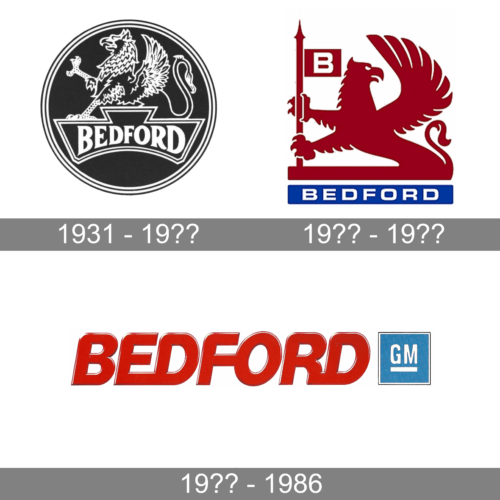
Early griffin roundel, c. 1930s
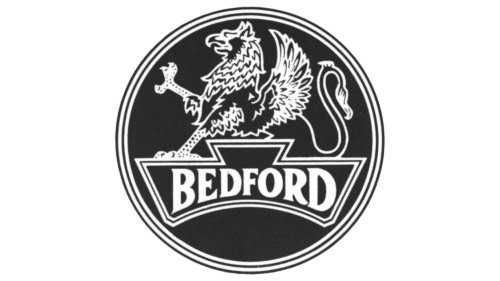
The earliest Bedford mark shown here is a circular badge built around a finely drawn griffin, with the brand name set on a decorative banner below. It is rendered in black and white, and the linework is dense and heraldic rather than simplified, a style that suited a small cast or etched plate on the front of a commercial vehicle. Treat it as an opening-era badge rather than a mark pinned to an exact year.
Mid-century identity
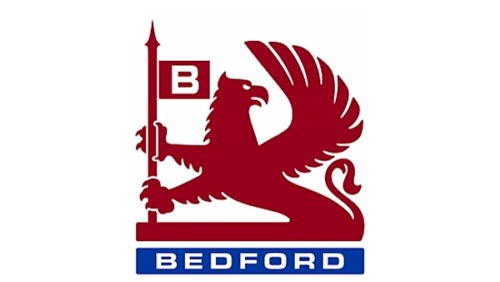
At some point in the middle decades of the century the griffin was redrawn as a solid crimson silhouette, losing most of its internal detail, and paired with a blue rectangular nameplate carrying the Bedford name in white capital letters. The overall reading is bolder and easier to reproduce at distance, which is what a badge on a truck cab or a van grille needs. The exact dates of this stage are not well documented in available sources, so it is best described as a mid-century identity rather than assigned a year range.
The flag in this artwork should be read as the Vauxhall device it actually is.
Final mark, before 1986
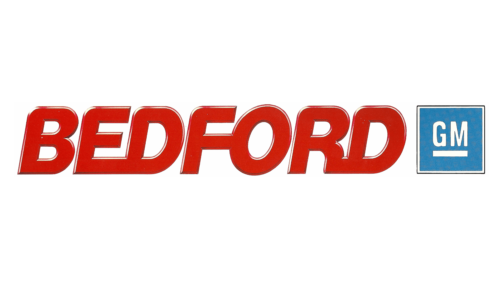
The last Bedford identity dropped the griffin altogether. The main image at the top of this page shows it: a heavy red Bedford inscription, with closely spaced characters and white shading that gives the letters a slight sense of volume, accompanied by a small blue square containing GM in white. A typeface name for this wordmark is not documented, and the shape is best described simply as a bold, compact sans serif. Pairing the marque name with the parent company’s initials was a straightforward statement of ownership: Bedford was a General Motors product line, and the badge said so. This is the mark that carried the brand through to the end of production.
What happened after 1986
Bedford vehicle production ended in 1986. The van operation at Luton was reorganised as IBC Vehicles, a joint business with Isuzu, while the truck side was later sold to AWD. The Bedford marque itself is defunct and is no longer in use; the griffin, meanwhile, remained with Vauxhall and has been revived on modern Vauxhall models. Anyone looking for a Bedford badge today is looking at a closed chapter of Vauxhall’s history, which is why the identity timeline is so much shorter than the Vauxhall one it borrows from.
The successor van business is covered in the IBC Vehicles profile.
FAQ
What was Bedford?
Bedford was the commercial-vehicle marque of Vauxhall Motors, General Motors’ British subsidiary. It produced trucks, vans and bus chassis at Luton and Dunstable from the early 1930s until production ended in 1986.
Was Bedford a car manufacturer?
No. Despite being described that way in some summaries, Bedford built commercial vehicles, including light and heavy trucks, vans and bus chassis. Passenger cars in the Vauxhall range were sold under the Vauxhall name.
Did Bedford have its own logo?
Mostly it used Vauxhall’s griffin emblem with the Bedford name attached on a roundel or nameplate. Only in the final stage did a Bedford-only wordmark, paired with a small blue GM square, replace the griffin.
What does the griffin on the Bedford logo mean?
The griffin is taken from the arms of Fulk le Breant, a thirteenth-century mercenary granted the Manor of Luton by King John. Vauxhall adopted the griffin as its trademark in 1915, and Bedford, as a Vauxhall marque, inherited it.
When did Bedford stop making vehicles?
Bedford-badged production ended in 1986. The van plant became IBC Vehicles, a venture with Isuzu, and the truck operation later passed to AWD. The Bedford marque has not been used since.
Disclaimer
This article is part of the educational resources provided by Logo Index, an independent archive covering logos, visual identities and graphic design history. Bedford and associated trademarks and brand assets remain the property of their respective rights holders where applicable.