Invicta is a British motor marque, and the name has been attached to enough unconnected ventures that it pays to be specific before discussing its badge. This Invicta was founded in 1925 by the ex-racing driver Noel Campbell Macklin, assembled at first in outbuildings at his home, The Fairmile in Cobham, Surrey, and financed by Oliver Lyle of the Tate and Lyle sugar family, with his brother Philip Lyle and Earl Fitzwilliam also credited as backers. William G. Watson was chief engineer. It is unrelated to the Invicta Watch Group, to the Buick Invicta of 1959 to 1963, and to the various short-lived companies that used the name before and after it.
 Invicta Logo PNG
The badge changed at least three times, and the changes do not follow a single coordinated branding programme. No official redesign announcement survives for any era, so the account below rests on period objects, specialist reference work and marque histories rather than on brand guidelines.
A plain nameplate, 1925 to about 1930
The earliest Invicta badge carried no wings at all. According to the specialist reference Car Emblems, and corroborated by the Norwegian motoring archive BilNorge, cars of this period wore a rectangular plate with scalloped corners bearing the word INVICTA in black-enamelled block letters. BilNorge adds that the mark was simply the marque name on a plate and was regarded at the time as dull. Whatever the merits of that judgement, the important point for anyone reading the badge today is that wings were not part of the identity at launch.
Wings arrive around 1930
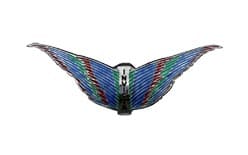
Around 1930, as the S-type was being built, the plain nameplate gave way to a colourful winged emblem rendered in red, blue and green on a golden background. The S-type was shown at Olympia in 1930, and the Invicta Car Club traces the model through that period. No reliable source explains why wings were chosen, and no designer or agency credit for the emblem is documented. Car Emblems describes the motif neutrally, as well-plumed ornithological wings, without assigning it any meaning, so claims that the feathers stand for speed or freedom are not supported by the available evidence.
Invicta operated from Cobham between 1925 and 1933, then ran a service depot in Flood Street, Chelsea, until 1938. When pre-war car production actually ended is not settled: BilNorge places the last car in October 1933, while Wikipedia and the marque club suggest the line trailed off around 1935. What is on record is that Invicta Cars Limited received a compulsory winding-up order on 3 May 1938.
The nameplate returns on the Black Prince
The marque was revived in 1946 at Virginia Water in Surrey, and roughly sixteen Black Prince cars were built. Those cars went back to the earlier rectangular badge rather than the winged one, a rare case of a maker reinstating its first, plainer mark. The second revival was short: the business was bought by AFN Ltd, the Frazer Nash concern, in 1950.
The winged badge on the 2002 S1
The name resurfaced again in 1989, when Christopher Browning registered Invicta Cars Ltd and went on to build continuation S-types. The modern revival is credited to Michael Bristow as chairman, who is said to have acquired the brand rights either in 1980 or around 2000, depending on the source. The car that followed, the Invicta S1, was hand-built in Chippenham, Wiltshire, and unveiled on 22 October 2002 at the British International Motor Show at the Birmingham NEC, priced from £69,950.
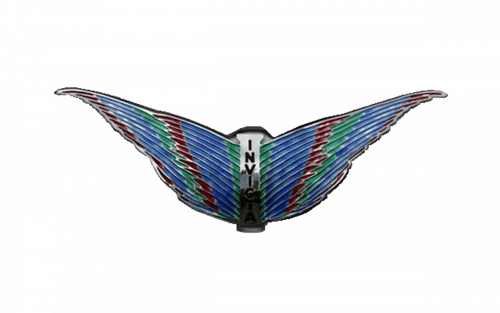
Its badge is the most discussed of the three. Per Car Emblems, the design centres on a prominent chrome vertical that reads like a capital T, down which the letters of INVICTA are stacked one above the other, flanked by wings whose enamel feathers run from green through blue to red at the tips. The Times described it simply as a pretty winged badge on the nose, while BilNorge treats it as approximately the same emblem as the S-type’s, with the colours repositioned. The older rectangular badge was not discarded altogether: it is embossed on the S1’s leather seats.
The company, later renamed Westpoint Car Company, was wound up in April 2012, although at least one retrospective account dates the collapse to 2011.
What the record does not settle
Several details people ask about are simply not documented. No source identifies a typeface or lettering style for any of the badges. No designer or agency credit has been traced for the winged emblem, and no company statement explains what the wings were intended to convey. Colour descriptions also drift: the widely repeated palette of silver, red, blue and green only partly matches the evidence, since gold backgrounds and chrome or black elements are what the sources actually record, and no silver specification appears. The S1 badge is also the only one with a reasonably detailed published description, which is why the earlier marks are usually described from object photographs rather than from written records.
FAQ
Did the original Invicta logo have wings?
No. The badge from 1925 to roughly 1930 was a rectangular plate with a scalloped edge and the word INVICTA in black-enamelled block letters. Wings appear to have been added around 1930, in connection with the S-type.
Is the Invicta car logo the same as the Invicta watch logo?
No. The Invicta Watch Group is an entirely separate company. The winged car badge belongs to the British motor marque founded in Cobham, Surrey, in 1925, and it is also unrelated to the Buick Invicta model name.
What colours are on the Invicta badge?
The winged emblems are described in red, blue and green on a gold ground, with chrome and black elements in the 2002 S1 version. Descriptions that add silver to that palette are not matched by the documented sources.
Disclaimer
This article is part of the educational resources provided by Logo Index, an independent archive covering logos, visual identities and graphic design history. Invicta and associated trademarks and brand assets remain the property of their respective rights holders where applicable.