Mitsubishi’s three-diamond mark, known in Japanese as the surī daiya, is the shared corporate emblem of the Mitsubishi group of companies rather than a badge belonging to any single subsidiary. The same geometric symbol appears across the group’s businesses, and for readers arriving from the automotive side it is the mark carried on vehicles built by Mitsubishi Motors Corporation. That shared ownership is the first thing to understand about the logo: the carmaker uses the emblem, but it did not invent it.
 Mitsubishi Logo PNG
Where the three diamonds come from
The emblem is a merger of two family crests. It combines the three-leaf crest of the Tosa clan, the domain that employed Yataro Iwasaki before he went into business, with the three stacked rhombuses of the Iwasaki family crest. Both the Mitsubishi group’s own account of the mark and Mitsubishi Electric’s history page describe the symbol as exactly this pairing, which is why the finished mark reads as two different traditions pressed into one shape.
The name explains the geometry. Mitsubishi joins mitsu, meaning three, with hishi, a word for the water chestnut that Japanese also uses to describe a rhombus or diamond. The medial “h” shifts to “b” in the compound, giving mitsubishi rather than mitsuhishi. So the three-diamond mark is, quite literally, a picture of the company’s name.
The form of the mark, and how it settled
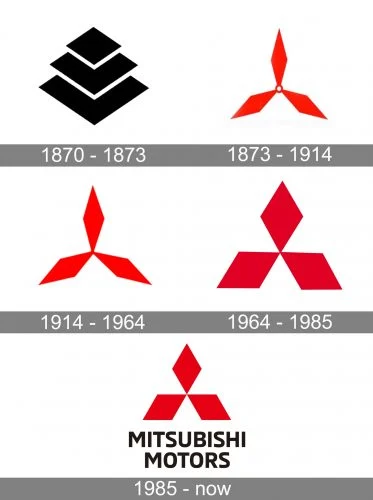
The oldest documented version of the group’s ship flag, sometimes called the sankaku-bishi, arranged thin rhombuses radially around a central point so each diamond came to a narrow tip. Japanese reference material on the surī daiya, drawing on Mitsubishi’s own archival history, puts that tip at roughly 30 degrees against the roughly 60-degree angle used today, which is what makes the modern mark look broader and more evenly balanced than its forerunner.
The arrangement recognised today took shape in 1910. Mitsubishi Motors’ company Q&A on the mark places the current three-diamond composition in Meiji 43, when it appeared on an English-language sales catalogue, and Mitsubishi Motors Vietnam’s heritage page repeats the same date. From that point the emblem’s outline is essentially the one still in use.
Legal protection followed a few years later. The Mitsubishi group registered the three-diamond mark as a trademark in 1914 through Mitsubishi Goshi Kaisha, covering seven of the sixty-seven product classes then available. A separate 1903 registration for a similar diamond device belongs to Mitsubishi Pencil, an unrelated company that is not part of the group, so the two records should not be conflated. Group companies have since built up close to 4,500 registrations for the mark across more than 140 countries.
Why the mark is red
The colour has a practical origin rather than a symbolic one. Mitsubishi Motors’ own Q&A states that the firm flew a red three-diamond on a white ground from its transport ships and flags, and that this is the source of the red now used in the logo. It is a common assumption that the red echoes the Japanese flag, but the documented explanation is the shipping livery, which predates the emblem’s use as a consumer brand.
How the carmaker came to use it
The Mitsubishi Motors Corporation was incorporated in April 1970 and began operations that June, taking over the motor-vehicle division of Mitsubishi Heavy Industries. The company’s first car wore the group emblem much earlier: the Model A of 1917 was the first Mitsubishi-badged automobile, built in small numbers. The emblem, in other words, was already half a century old by the time the car business became a separate company, as the Mitsubishi Motors integrated report and Hemmings’ company history both record.
For a period the cars did not use the three diamonds at all. Mitsubishi Motors’ company history notes that an “MMC” letterform mark appeared on vehicle fronts from around 1982, and that in May 1992 the company replaced the MMC mark with the three-diamond logo across advertising, dealerships and car bodies. The 1992 switch is the point at which the corporate emblem became the everyday automotive badge it is now.
The 2017 brand renewal
The most recent identity work kept the symbol and touched only the surrounding typography. On 25 October 2017, at the 45th Tokyo Motor Show, Mitsubishi Motors introduced a new brand strategy and the tagline “Drive your Ambition”, its first new tagline in more than ten years and a replacement for “Drive@earth”. The three diamonds were left unchanged; the wordmark beside them was redrawn in a bolder, wider form that extends beyond the width of the diamond cluster, with the tagline set beneath. A global dealer visual identity followed in 2018.
Read together, the emblem’s history is unusually stable. A ship flag from the 1870s settled into its present outline in 1910, was registered in 1914, was readopted by the carmaker in 1992, and survived a full brand refresh in 2017 without being redrawn. Its staying power comes from the way it encodes the name and the founding families in a single, unmistakable shape rather than from any later restyling.
FAQ
What do the three diamonds in the Mitsubishi logo mean?
The three diamonds combine two family crests: the three-leaf crest of the Tosa clan, where the founder Yataro Iwasaki first worked, and the three stacked rhombuses of the Iwasaki family crest. The shape also echoes the company name, since mitsu means three and hishi describes a rhombus.
When was the Mitsubishi logo created?
The current three-diamond composition appeared in 1910 on an English-language sales catalogue, and the Mitsubishi group registered it as a trademark in 1914. Earlier versions of the mark used narrower, thinner diamonds arranged around a central point.
Why is the Mitsubishi logo red?
Mitsubishi flew a red three-diamond on a white ground from its transport ships and flags, and that is the documented source of the red used in the logo today, rather than any reference to the Japanese flag.
Disclaimer
This article is part of the educational resources provided by Logo Index, an independent archive covering logos, visual identities and graphic design history. Mitsubishi and associated trademarks and brand assets remain the property of their respective rights holders where applicable.