JAC is the public-facing brand of Anhui Jianghuai Automobile Group Corp., Ltd., a provincially state-owned Chinese automaker headquartered in Hefei, Anhui. The company builds trucks, pickups, vans, buses and passenger cars, and its badge has changed shape twice in two decades: from a lettering mark, to a five-pointed star, to the elliptical shield it uses today.
 JAC Logo PNG
Meaning and history
JAC’s corporate lineage runs well before the automobile business. A Hefei press history of the company traces it to a Chaohu sluice-machinery repair works set up in 1958, which relocated to Hefei in 1962 and became the Chaohu Auto Parts Factory on 20 May 1964. A first 2.5-tonne truck was completed in April 1968, and the “Jianghuai” name was applied and batch production began the following year. Earlier commercial milestones that shaped the brand’s reputation came later: a first dedicated bus chassis, the HFC6700, in 1990, and a period in the mid-1990s when JAC’s seven-metre chassis reportedly supplied around 80 percent of that segment, and the first Refine MPV, which rolled off the line on 18 March 2002 using licensed Hyundai H-1 technology.
The corporate structure arrived in layers. Anhui Jianghuai Automobile Group Co., Ltd. was founded on 18 May 1997, while the listed operating company, Anhui Jianghuai Automobile Co., Ltd., was incorporated on 30 September 1999 and listed on the Shanghai Stock Exchange on 24 August 2001 under code 600418, according to the company’s SSE listing filing.
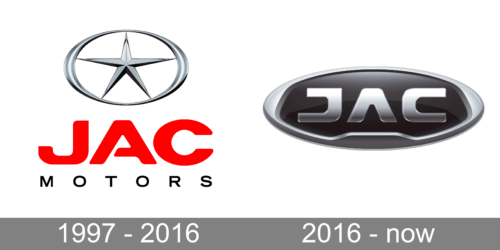
Before 2006: the JAC lettering on commercial vehicles
For most of the company’s early decades the identity was split rather than singular. The “JAC” lettering, drawn from the English name Jianghuai Automobile Co., Ltd., served as the commercial-vehicle emblem, while passenger cars carried a different mark. A Chinese compilation of automotive badges describes the lettering as italic capitals set on a blue ground inside an ellipse, though this account is a secondary industry reference rather than a company specification.
The five-pointed star, 2006 to 2016
In 2006 JAC replaced its usual car emblem with a new five-pointed star, debuting it on the Ruiying SUV and showing the mark at that year’s Beijing auto show, as reported in the Chinese motoring press at the time. The star became the passenger-car brand mark and stayed in service for roughly a decade. The exact month of its debut is not consistently documented: some accounts point to the October 2006 Ruiying launch, others to the November 2006 auto show.
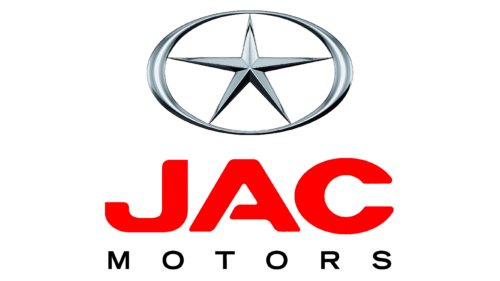
A Chinese automotive-badge compilation links the star’s five points to five stakeholder groups, customers, employees, shareholders, upstream and downstream partners, and related parties, with the ellipse standing for global resources. That reading is an industry interpretation and is not repeated in JAC’s own materials. It is also worth noting that the star was not the company’s only mark during this period. Because the “JAC” lettering continued on commercial vehicles, there was no single unified logo spanning 1997 to 2016, which is how the badge’s earlier chronology is sometimes summarised.
The 2016 shield emblem
On 12 April 2016, at a brand event in Hefei ahead of the Beijing auto show, JAC unveiled a new passenger-car emblem: an ellipse enclosing the “JAC” letters inside a metallic frame. The People’s Daily report framed the change as a move from five stars to the JAC shield, and the company presented it as a return to “one JAC,” reunifying the commercial- and passenger-vehicle identities. The new mark rolled out on new passenger models first, with existing models switching over at facelift or generation change.
JAC set out an official reading of the new emblem at launch. According to China Economic Net and Xinhua-sourced coverage, the ellipse signifies integrating resources to build world cars; the overall shield-like form signifies self-reliance and steady advance; the metallic frame wrapping the letters signifies manufacturing precision and quality; and the letters, styled to suggest a human face, signify care for people and customers.
No designer or agency credit for the 2016 emblem is documented in accessible sources. One automotive-media account refers to an internal 2015 fan-design contest, saying the winning entries were not used in the final mark, but that claim is not corroborated and the design is generally attributed to JAC’s own team.
Ownership and the current identity
JAC is an Anhui provincial state-owned enterprise, and its ownership has shifted in a way that affects how the identity is read. Since 2020, Volkswagen Group has held 50 percent of the parent JAC Holding Group, giving it an indirect stake of roughly 14 percent in the listed company. The brand floor around JAC has also moved: the SOL passenger brand launched in 2018 through the Volkswagen joint venture, the JAC name was realigned toward commercial vehicles in 2020, and a new passenger sub-brand, Yiwei, arrived in 2023. JAC is one of the larger automakers in China, part of a broader group of major Chinese brand identities.
Production capacity was estimated at more than 500,000 vehicles a year around 2009, though that figure describes capacity rather than current output. Recent sales figures are lower: roughly 403,100 vehicles and chassis in 2024 and about 384,100 in 2025, both provisional figures reported by Chinese motoring media.
Disclaimer
This article is part of the educational resources provided by Logo Index, an independent archive covering logos, visual identities and graphic design history. JAC and associated trademarks and brand assets remain the property of their respective rights holders where applicable.