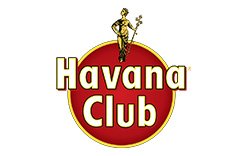
The Havana Club logo shown here pairs a red roundel edged in gold with the HAVANA CLUB wordmark and a small figure above it. A script tagline sits beneath the roundel. The figure is La Giraldilla, a symbol of Havana that has also featured centrally in recent Havana Club designs. The name is used by two unrelated claimants: the Cuban brand made and exported by Havana Club International S.A., a joint venture of Cuba Ron and Pernod Ricard, and Bacardi’s separate US-market brand. (Pernod Ricard; The Drinks Business)
The Cuban brand’s identity has been adapted across different product ranges. A core-range refresh introduced in 2024 changed label artwork and packaging details; the Icónica range received a broader redesign in 2024, and the ready-to-drink range was redesigned that year as well. These updates varied by range rather than representing one identical redesign across every Havana Club product. (The Spirits Business; Forbes; Transform)
 Havana Club Logo PNG
Meaning and history
Havana Club began as a rum brand launched in 1934 by José Arechabala S.A., a company established in Cuba. The Cuban registration record and a 1935 US registration document the early mark; Bacardi has separately described the brand as created in 1935. The Havana Club bar and offices opened in Havana in May 1935. (The Trademark Reporter; Bacardi Limited)
1934 – Today
This stage shows the roundel, stacked wordmark and figure above it, with the script tagline below. Its arrangement is a useful reference for the recognizable elements of the identity, but the Cuban brand’s later range redesigns mean that this image alone does not represent every current product treatment.
Logo elements and recent redesigns
The red-and-gold roundel gives the mark a compact, enclosed shape, while the two-line wordmark remains legible within it. La Giraldilla appears above the circle. The figure is associated with Havana and with cubanía; recent designs for the Icónica range and Icónica Selección de Maestros have placed the motif prominently. (Forbes; Radio Havana Cuba)
The core-range refresh, announced in December 2023 and rolled out from January 2024, added architectural imagery inspired by Havana iron doorways to Añejo 7 Años artwork. It also added founder Don José Navarro’s signature, put La Giraldilla on the Especial and Original capsules, and introduced QR e-labels. (The Spirits Business)
In 2024, the Icónica range received a wider reimagining that included its logo and labels. The redesign used a gilt label, a fluted bottle and wooden stoppers, with La Giraldilla at the centre of the composition. (Forbes)
The ready-to-drink range took a separate visual direction in 2024. JDO’s redesign introduced a new colour system and palm-leaf graphics, and the agency described its work as enhancing the logo’s boldness. In 2025, the Cuban side presented a new look for Icónica Selección de Maestros inspired by La Giraldilla. (Transform; Radio Havana Cuba)
Two claimants to the Havana Club name
The Cuban and Bacardi brands have separate histories and market positions. Havana Club International was formed in November 1993 as a 50/50 joint venture between Cuba Ron and Pernod Ricard, distributing the Cuban brand outside the United States. Bacardi acquired the Arechabala family’s claimed rights to the name in the mid-1990s and sells its own Havana Club in the US. (Pernod Ricard; The Drinks Business)
The Cuban marks were transferred to the state enterprise Cubaexport in 1966. Cubaexport later filed a US application, and the mark registered there in 1976. The registration has been at the centre of long-running disputes involving Bacardi; the Fourth Circuit affirmed dismissal of the latest challenge in June 2026. (US litigation filing; The Drinks Business)
Disclaimer
This article is part of the educational resources provided by Logo Index, an independent archive covering logos, visual identities and graphic design history. Havana Club and associated trademarks and brand assets remain the property of their respective rights holders where applicable.