Microcar is the name of a French marque of voitures sans permis: the light, licence-exempt quadricycles in the L6e and L7e categories that can be driven in France without a standard driving licence. The vehicles sold in considerable numbers for four decades. The badge they carried is a different story, and a thinner one. Only one early emblem is described in any substance by a reliable source, and the marque itself was retired in 2025.
 Microcar Logo PNG
The badge that sources actually describe
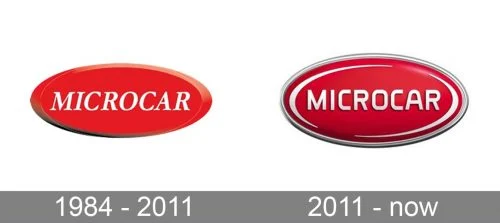
The most substantive description of a Microcar emblem comes from the Norwegian car-history archive BilNorge, which records an early mark as a simple red oval with a thin border and the brand name written in white inside it. That construction visually echoes Bugatti’s classic oval, though the resemblance is a matter of form rather than any documented reference. The same source presents the emblem as consistent with the plain, functional character of the vehicles.
Beyond that starting point, the identity’s chronology is not well documented. No brand guidelines, press asset, designer credit or agency attribution describing the mark was located in the research behind this profile, and the year of any later change to the badge is not established. That is unusual for a marque of Microcar’s commercial scale, but it reflects the source record rather than any deliberate secrecy.
Where the name and company came from
The name is descriptive rather than symbolic: the company built small, inexpensive vehicles from the outset and never made anything else. Its corporate origin lies with the boatbuilder Jeanneau, whose automobile department developed a small-car project from around 1980, following Jean-Serge Aziosmanoff’s earlier Mini-Cat design. The Microcar company itself is dated to 1984 at Montaigu in the Vendée by the INA television archive, which also reported the launch of the first licence-free voiturette, the diesel Speed, in 1988.
Jeanneau passed into Groupe Bénéteau in the mid-1990s, and Microcar became a Bénéteau subsidiary around 2000. This is the origin of a persistent misconception that Microcar was a boatbuilder that switched to cars in 2008. The parent group built boats. Microcar always built small vehicles, and the boatbuilding connection belongs to its former owner, not to its products.
Ligier, and the end of the marque
Microcar changed hands in 2008. The private-equity firm 21 Centrale Partners, recorded in Italian filings as 21 Investimenti Partners, agreed to acquire 100 percent of the company under a share-purchase contract dated 23 May 2008, having already signed for Automobiles Ligier on 16 May; Spain’s competition authority logged the notification on 30 May 2008 in its file C/0075/08. Completion was reported that September, with Philippe Ligier as president of the combined business. The two marques kept separate badges, plants and dealer networks, operating under a group that became Ligier Group in 2014. In the sans-permis market the group was long reported as number two behind Aixam, even as Microcar positioned itself as the more affordable option.
That dual-brand structure ended recently. Ligier Group halted commercialisation of Microcar models on 1 January 2025, dropping the brand for image reasons and to reduce communication costs, Challenges reported, even though Microcar was outselling its sister marque at the time. Days later, at a works council meeting on 8 January 2025, with some reports giving 9 January, the group announced the closure of the Boufféré plant at Montaigu-Vendée, a site inherited with the 2008 Bénéteau purchase, and the transfer of production to Abrest by September 2025, according to France 3 Régions. The company left open the possibility that the name could return for something entirely different, which leaves the emblem without a settled future.
Font, colour and the limits of the record
The badge is better evidenced by colour than by typography. White lettering on a red ground is the one combination that appears in the specialist record, and it stayed recognisable across the marque’s life. Suggestions of a specific typeface, a later geometric sans, silver orbit lines, or an ecological reading of the palette are not supported by any reliable source. What the available material supports is a mark defined by simplicity and consistency rather than by a documented redesign programme.
Disclaimer
This article is part of the educational resources provided by Logo Index, an independent archive covering logos, visual identities and graphic design history. Microcar and associated trademarks and brand assets remain the property of their respective rights holders where applicable.